


Summary
- Black Forest Labs opened FLUX 3 Video to general availability on August 4. It can now be called directly through the BFL API and select partners, with no more approval wait.
- Clips up to 20 seconds long are generated together with dialogue, sound effects, and ambient sound. HD costs $0.17 per second, FHD $0.29 per second, and draft mode $0.06 per second.
- Korean is not on the list of officially supported languages. An open-weight FLUX 3 Dev has only been teased, with no date attached.
Black Forest Labs opened FLUX 3 Video to general availability on August 4. At last month's July 23 announcement, it was early access gated by application and approval; now it can be called directly through the company's own API and select partners. It generates clips up to 20 seconds long from text or images, producing dialogue, sound effects, and ambient sound within the same generation pass.
Black Forest Labs is an AI lab of roughly 70 people with research operations in Freiburg, Germany, and San Francisco. Its founding team includes researchers behind Latent Diffusion, Stable Diffusion, and FLUX.1. FLUX 1 and FLUX 2 produced only images; this marks the company's first video model.
The July 23 announcement and the August 4 launch are two different events
The two dates have been circulating in a mixed-up way, so a distinction is needed. July 23 was the announcement revealing the existence of FLUX 3, a multimodal foundation model. What was disclosed that day was the design — jointly training image, video, audio, and action prediction within a single architecture — along with early evaluation figures, while actual use remained locked behind approval-gated early access.
What changed on August 4 is access. The company stated that day that "the initial version generating from text and images is now generally available through the BFL API and select partners." A 60-second introduction video was posted to the official YouTube channel the same day, alongside a separate technical blog post and a 3-minute-50-second video covering a robotics collaboration model. Video editing features and the Omni Reference function, which combines image and video references, have not yet shipped, and the company still labels FLUX 3 as a "preview" model.
Three modes, one-line requests
FLUX 3 Video runs on a single endpoint, api.bfl.ai/v1/flux-3-video. Each request specifies a mode: text-to-video (t2v), which starts from a prompt alone; image-to-video (i2v), which starts from an image; and video continuation (v2v), which extends an existing clip. The rest of the request format is identical across all three modes.
Image-to-video has no separate field for a starting frame. There is only one channel for passing images, keyframes; if you provide a single image, that becomes the starting frame. Provide two, and they become the start and end frames; you can supply up to ten images to storyboard an entire clip. Passing pairs in the form [second, image] lets you pin each image to a precise timestamp — for example, locking frames at 0 seconds and 8 seconds and leaving the motion in between to the model.
Video continuation works by passing an existing clip via start_video and writing what happens next. Per the company's description, it accepts up to 4 seconds of existing video and audio as input and carries motion, camera behavior, dialogue, and sound forward across the seam. It also supports changing scenes and camera angles multiple times within a single generation.
All remaining fields are optional. Aspect ratio (aspect_ratio) and duration (duration) default to auto and are set automatically based on content; resolution (resolution) defaults to HD; and audio generation (generate_audio) defaults to on. Calls are asynchronous — submitting a request returns a job ID and polling URL, and you check that address until status becomes Ready. Output URLs are signed and expire roughly two hours after job completion, so any pipeline must include an immediate download step to move results into your own storage.
Draft mode costs a third of full-quality rendering
The published pricing is per-second. Text-to-video and image-to-video cost $0.17 per second at HD and $0.29 per second at FHD, with durations from 5 to 20 seconds selectable. Video continuation costs more than double that — $0.43 per second at HD and $0.54 per second at FHD — with a shorter maximum duration of 15 seconds. Frame rate is fixed at 24fps, and supported aspect ratios are 21:9, 2:1, 16:9, 4:3, 1:1, 3:4, and 9:16.
| Mode | Input | Duration | Full Render | Draft |
|---|---|---|---|---|
| Text-to-video | Prompt | 5–20s | HD $0.17/s, FHD $0.29/s | $0.06/s |
| Image-to-video | Prompt + 1–10 images | 5–20s | HD $0.17/s, FHD $0.29/s | $0.06/s |
| Video continuation | Prompt + existing clip | 5–15s | HD $0.43/s, FHD $0.54/s | $0.12/s |
The key to the cost structure is draft mode. Setting draft: true in a request produces a fast preview at $0.06 per second, and the result comes bundled with a draft_cache. Once you land on a preview you like, resubmitting that bundle in draft_enhance mode re-renders the same scene at full quality using the same seed. The company specifies that each newly submitted request is an independent generation, meaning a full-quality render can turn out different from the draft. In other words, to get exactly the shot you picked in draft form, you must go through the draft_enhance path rather than resubmitting from scratch. For a 10-second HD clip, that works out to $0.6 for draft exploration and $1.7 for the confirmed render.
Building a video model produced a robot that could move
A second blog post published the same day reveals the real significance of this launch. Built on the FLUX 3 backbone, in collaboration with Zurich-based robotics company mimic, is a video-action model called "FLUX-mimic," which Audi is already testing and deploying on its production line.
The training composition the company disclosed explains why this connection is possible. More than 95% of FLUX 3's total training compute went into video prediction, with audio accounting for less than 0.5% of 720p video tokens. The logic is that producing realistic video forces the model to learn contact, motion, weight, and causality, and decoding actions from that learned world model yields robot control. The company said that when action prediction was added to the training curriculum midway through, human-evaluated video quality dropped by up to 10% before recovering to its original level within 3,500 steps — meaning the cost of adding a new modality was temporary.
The performance figures are specific too. FLUX-mimic's backbone processes input into world representation in under 80 milliseconds on a single NVIDIA RTX 5090, and the full robotic system's end-to-end response time, including mimic's deployment stack, is 101 milliseconds. Training data comprised tens of millions of hours of general video plus hundreds of thousands of hours focused on human and robot manipulation. Christoph Schneider of Audi's Production Lab said, "We've seen these robots perform complex, deformable-object manipulation tasks that were previously impossible with conventional robotics."
Scorsese joined in June
The frequently mentioned advisory appointment of Martin Scorsese is actually a separate event from two months earlier, not part of this launch. The company launched a dedicated page on June 2 announcing that Scorsese had joined as an advisor, accompanied by video of him doing storyboard work with FLUX. According to foreign press reports, his upcoming project is "What Happens at Night," starring Leonardo DiCaprio and Jennifer Lawrence.
Scorsese's own account focuses on communication rather than generation. "I've drawn my own storyboards for 70 years. Getting across what I see in my head to actors and crew has always been the challenge," he said, adding, "Now with this tool I can share what I've visualized more clearly and efficiently with production designers, art designers, and cinematographers." Citing his use of 3D in "Hugo" and de-aging in "The Irishman," he added, "Film is a young medium at only 125 years old, so we should stay open to how it evolves." The company described the relationship only as an "advisor" role and did not disclose equity, compensation, term, or project commitments.
What's still missing
The first thing to check is language. The languages the company lists as supported are English (multiple dialects), Chinese, Spanish, French, German, Japanese, Portuguese, Russian, Italian, Indonesian, Turkish, Hindi, Punjabi, "and others." Korean is not on this list. Because the list ends with "and others," full exclusion cannot be confirmed, but for any work requiring Korean dialogue and lip-sync, plans should not assume official support.
There's also an inconsistency in resolution labeling. The YouTube video description states "1080p native (2K and 4K coming soon)," but the official blog says the model ships at HD (720p) and Full HD (1080p), with Full HD produced via upscaling, and the API documentation likewise describes the fhd option as "finishing results at a higher resolution via a video upsampler." It's safer to go by the latter — the technical documentation — rather than the marketing copy. It's also worth noting that initial evaluations were conducted at 720p.
The benchmark figures are entirely self-reported. In the ELO comparison chart the company released, FLUX 3 ranks first in text-to-video with a score of 1135, followed by Gemini Omni Flash at 1090 and MiniMax H3 at 1082. Seedance 2.0 comes in at 1069, Kling v3 Pro at 1054, and Luma Ray 3.2 ranks lowest at 620. Image-to-video rankings are much tighter: FLUX 3 scores 1051, Seedance 2.0 scores 1049 — a two-point gap that's effectively a tie — with MiniMax H3 close behind at 1039. In this category, Runway Gen-4.5 ranks lowest at 876.
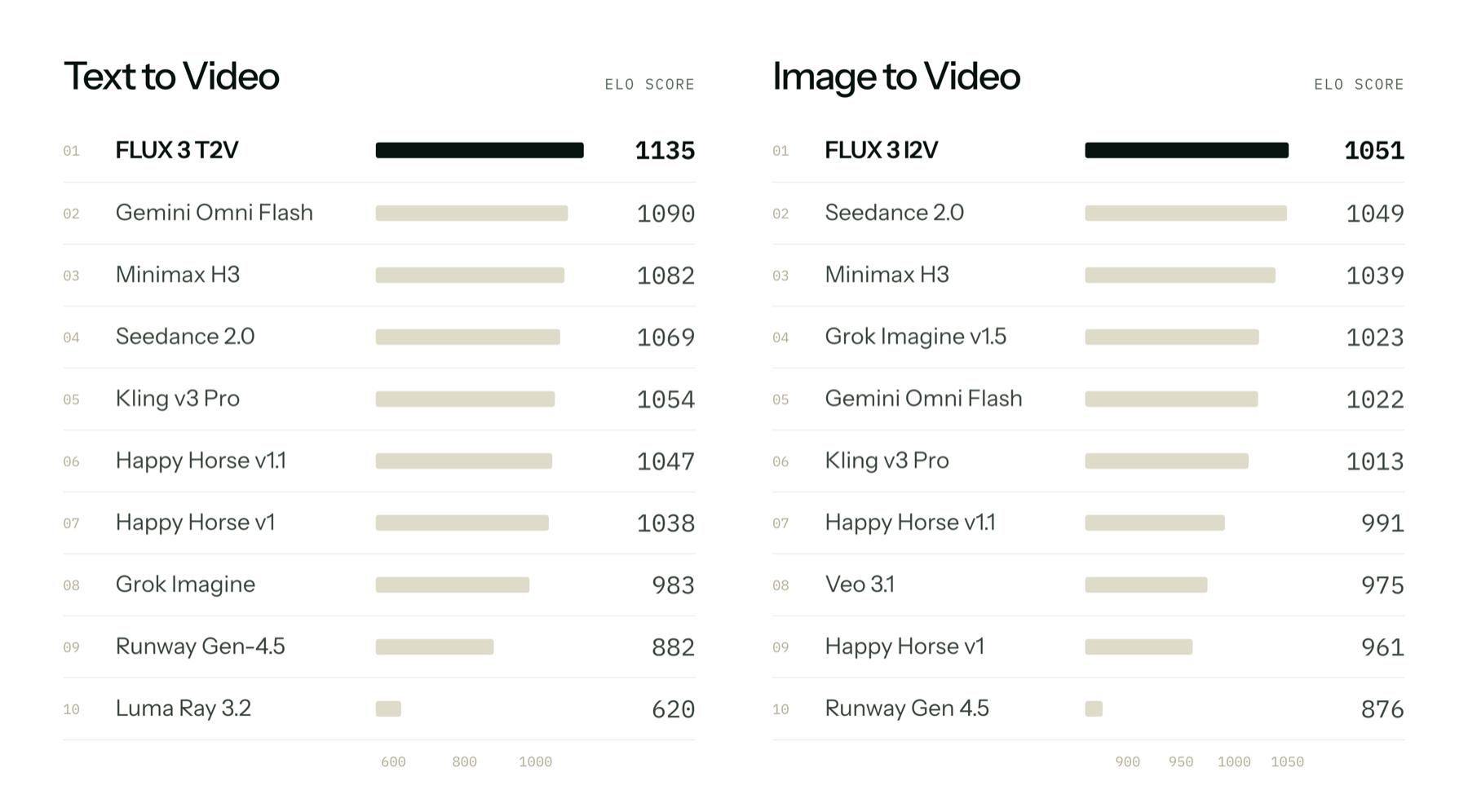
Note, however, that this chart reflects the company's own evaluation of its own model. No independent benchmark exists yet, and no service-level agreement (SLA) or throughput guarantees have been disclosed.
As for what's left on the roadmap: generation that combines image, video, and audio references; FLUX 3 Image, which will handle image generation and editing; and an open-weight version called FLUX 3 Dev are all teased, in that order. None of them, however, come with a date attached. For teams planning to self-host locally, the only option currently available remains the image-only FLUX.2 family. On the safety front, the company said it evaluated risk areas — including non-consensual intimate imagery (NCII) and child sexual abuse material (CSAM) — before launch, in partnership with third-party evaluator Cinder.


Comments