


Image: METAL
Summary
- Intelligence Age, the blog of OpenAI's Strategic Futures team, published The eternal complement on October 1, the first essay in its Next Economy series.
- Authors Hemanth Asirvatham and Elliott Mokski cite research showing that effective research effort in the US economy has risen 23-fold since the 1930s while research productivity has fallen by a factor of 41, pointing to execution rather than ideas as the bottleneck.
- The essay contrasts a civilization of depth, in which superintelligence economizes on experiments, with a civilization of width, in which vast execution systems keep growing and most machine intelligence ends up doing the work of bureaucracy.
Intelligence Age, the blog of OpenAI's Strategic Futures team, on October 1 (US time) published The eternal complement, the first essay in its Next Economy series. It is written by Hemanth Asirvatham and Elliott Mokski. The essay's conclusion is that in an age of superintelligence, most machine intelligence may be spent not on flashes of discovery but on execution and coordination, the work of turning ideas into reality, in other words the work of bureaucracy. The authors say the piece is part of a new platform hosting independent voices exploring a post-AGI future, and that it reflects their own views rather than those of OpenAI or their colleagues.
Intelligence Age launched on August 20 with an inaugural post by Dean Ball. According to that post, the blog belongs to the Strategic Futures team, a new small team inside OpenAI whose goal is to answer a single question: "how should free society be restructured to preserve individual rights and agency while accommodating the emergence of transformative AI?" Ball argued that this category, known in AI policy circles as concentration-of-power risk, is in the long run the largest and most serious. A note at the end of the post says the blog was renamed once to avoid confusion with the non-profit AI Futures Project.
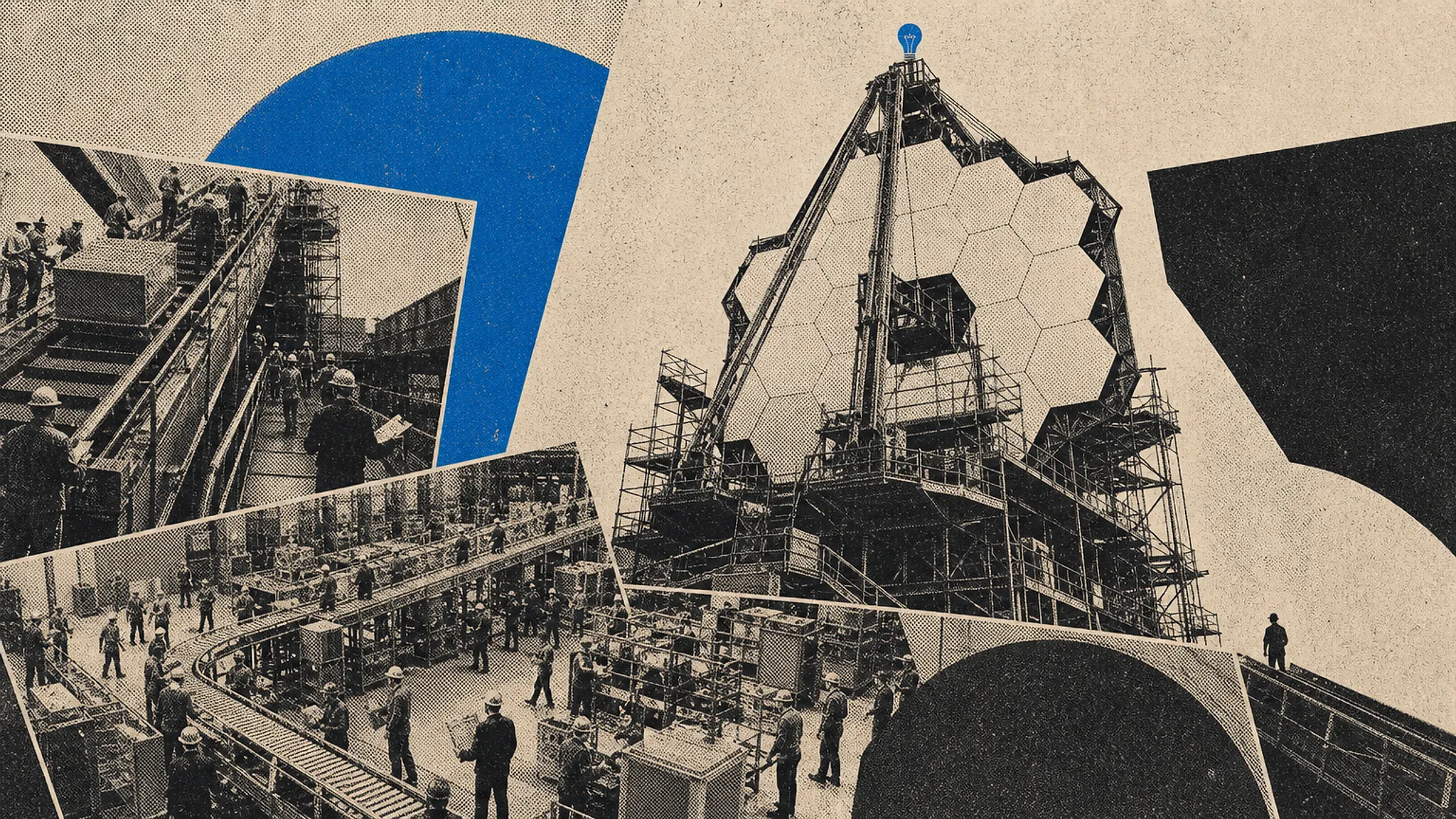
The essay opens with telescopes. Galileo widened humanity's sight with two lenses and a tube, but the James Webb Space Telescope, built to widen it again, is a ten-billion-dollar observatory. It was folded inside a rocket and sent a million miles away, its eighteen enormous mirror segments were engineered to fifty-nanometer precision, and three hundred organizations across fourteen countries took part in building it. The authors write that seeing farther took not just brighter minds but a larger bureaucracy.
The numbers they offer concern falling research productivity. Citing work by economist Nicholas Bloom and his coauthors, the essay says sustaining Moore's law now requires more than eighteen times as many researchers as in the early 1970s, and that since the 1930s effective research effort across the US economy has risen 23-fold while measured research productivity has fallen by a factor of 41. According to the original paper, which METAL checked (American Economic Review, 2020, 41 pages), research effort grew at an average of 4.3 percent a year over that period while research productivity fell by an average of 5.1 percent a year. The essay adds that the technician workforce is growing twice as fast as the scientists, that the use of specialized equipment in science has doubled over four decades, and that a chip fab today costs five times as much as one thirty years ago.
The National Science Foundation (NSF) statistical table the essay links to tells the same story. According to Table 50 of NSF report 25-354, which METAL checked, US domestic business R&D employment in 2023 was 2,126,000, of whom 1,437,000 were researchers and 148,000 were researchers with a PhD. R&D technicians and equivalent staff numbered 502,000 and other supporting staff 187,000, layer upon layer of people carrying out the execution behind each researcher's ideas.
The concept the authors bring in is the economist's complement. Two inputs are complements when more of one raises the value of the other: a better telescope makes a good astronomical question more valuable, and a better question makes the telescope more valuable. Some complements are visible, such as particle accelerators or energy, while others, such as laws, bureaucracy, funding mechanisms and supply chains, are harder to see. Because an idea must pass through a long chain of correct local actions across these institutions, the authors call this institutional intelligence, the intelligence of execution. Even if superintelligence is imagined as a billion Einsteins, the essay notes, that civilization would still need most of them to work the quarries and manage the accounting.
Today's AI is first making its mark on the other side. According to the authors, AI already writes code, searches unfamiliar literatures and turns sketches into working prototypes, making execution less scarce. Ideas that once required a whole organization can increasingly be pursued by one ambitious person, they explain, so that a filmmaker never handed two hundred million dollars, or a game designer who spends a career implementing other people's visions, can build work of their own. At this stage the scarce input moves from execution to taste, the ability to decide what is worth making and which question is worth asking.
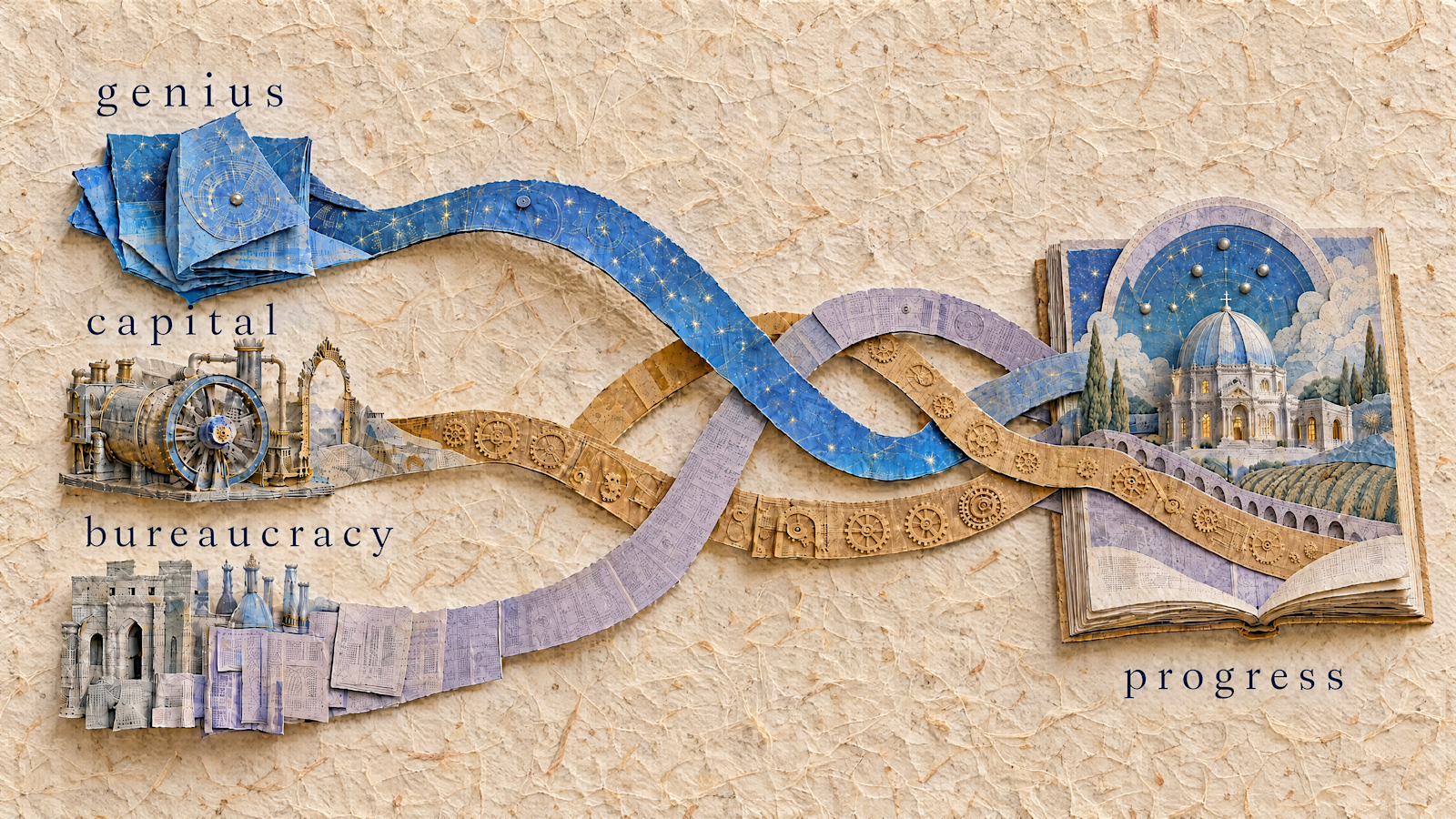
The authors suggest this may not be the end of the story. As AI begins arriving at new insights on its own, as may already be happening in domains such as math, it supplies research agendas as well as labor, and ideas pour out faster than the supporting infrastructure can absorb them. METAL has reported on OpenAI forming an independent advisory group of nine mathematicians, and the shift in mathematics the essay points to follows from that. If today's AI is a long-awaited reprieve in which good ideas finally get their due, the authors' diagnosis is that tomorrow there may be so many good ideas that we become more execution-starved than ever.
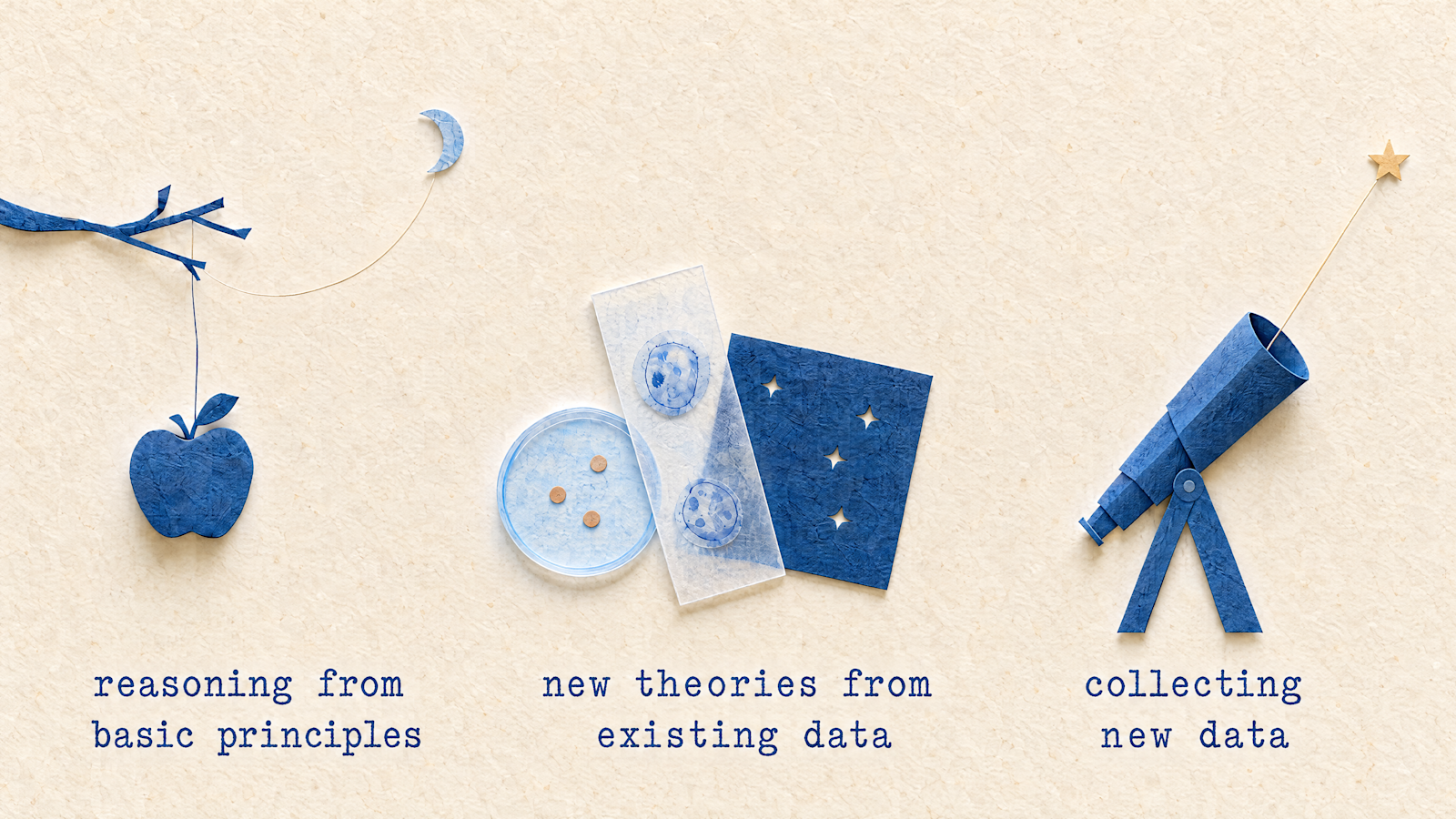
From here the essay sketches two civilizations. Intelligence can advance knowledge in three ways: reasoning from principles, drawing new insights from existing evidence, and gathering new evidence by observing and intervening in the world. A civilization of depth is one that travels far on the first two. Simulations screen out most hypotheses, and the experiments that must be checked against reality shrink to the few that truly matter. Pointing to Mendeleev, who described undiscovered elements from the gaps in the periodic table, and to the Standard Model, which led physicists to expect the Higgs boson decades before it was observed, the authors suggest a nearly complete science may be like a jigsaw puzzle whose final pieces are easier to place.
A civilization of width is one in which the third path becomes the bottleneck. The authors cite biology as its preview. Even as computers simulate biological processes, new medicines still have to be tested on large numbers of people, and the more candidates machines produce, the bigger the experimental bottleneck becomes. The essay writes that a superintelligence could design a century of experiments in an afternoon, then spend the century waiting for nature and machinery to follow through. In this world labs automate, factories multiply and energy production rises, and the extreme image of it is a Dyson sphere harvesting a star's energy. Saying such a project would be among the most repetitive, monotonous and organizationally challenging ever undertaken, the authors predict that "almost all machine intelligence would be deployed not to do the brilliant, but to do the boring."
The essay's final argument is that this does not make human curiosity worthless. The authors give three reasons: our obligation to understand the world for ourselves remains even if machines appear better at it; even if humans are worse at both, we may have a comparative advantage in frontier intelligence, where we are relatively better; and whatever uniqueness humans keep adds creative diversity. Most machine intelligence may stay inside its own self-sustaining apparatus, with only a fraction deployed at human creative behest, but the authors add that even that sliver would be far more than the resources humanity has today.
Seen through a sociologist's lens, the essay changes the protagonist of AI discourse. Stories of superintelligence have centered on genius, but this one restores to the core of intelligence the work of people erased from tales of great feats, like the welder of a screw that goes into the telescope or the insurer for a school. Read alongside the principles Ball laid out in the inaugural post, the question grows heavier. Ball warned that if states can project force without the cooperation of soldiers, police and a vast bureaucracy, power may no longer require a bargain with society as a whole, and he wrote that when AI takes high-stakes actions, those actions must be traceable to a responsible human or human-controlled organization. If machines take over the work of bureaucracy, the next question is who holds that bureaucracy's chain of approval.
The essay concludes that much of human intelligence today goes into the unsung work of turning ideas into reality, and that machine minds will inherit the same dependence. The authors write that machine minds "cannot all be luminaries. They must be bureaucrats too." Our story to come, and the pace of its progress, depend on whether great minds need more of the world or do more with less, the authors conclude.


Comments