



Image: METAL
Summary
- Google Research released its paper-verification agent Deep Review to the public on October 14 at Research@ 2026 in Mountain View and announced 10 research highlights.
- Deep Review uses a four-stage design in which multiple agents verify a document section by section in parallel; its predecessor PAT reviewed more than 16,000 manuscripts at STOC, ICML, NeurIPS and ICLR, and users get two free reviews a week.
- The Earth AI agent unveiled alongside it found 48 high-exposure settlements and more than 45,500 at-risk people within minutes early in an Ebola outbreak, and the open medical model MedGemma has passed 10 million downloads.
Google Research on October 14 released Deep Review, an agent that verifies research papers, to the public at Research@ 2026, its annual event held in Mountain View, California. Deep Review is an AI system that splits long scientific papers and technical documents into sections and has several reasoning agents review them at the same time. An experimental version has already reviewed more than 16,000 manuscripts at four top computer science conferences. At the same event, Google also unveiled 10 research highlights spanning Earth observation AI, scientific research tools, medical AI and flood prediction.
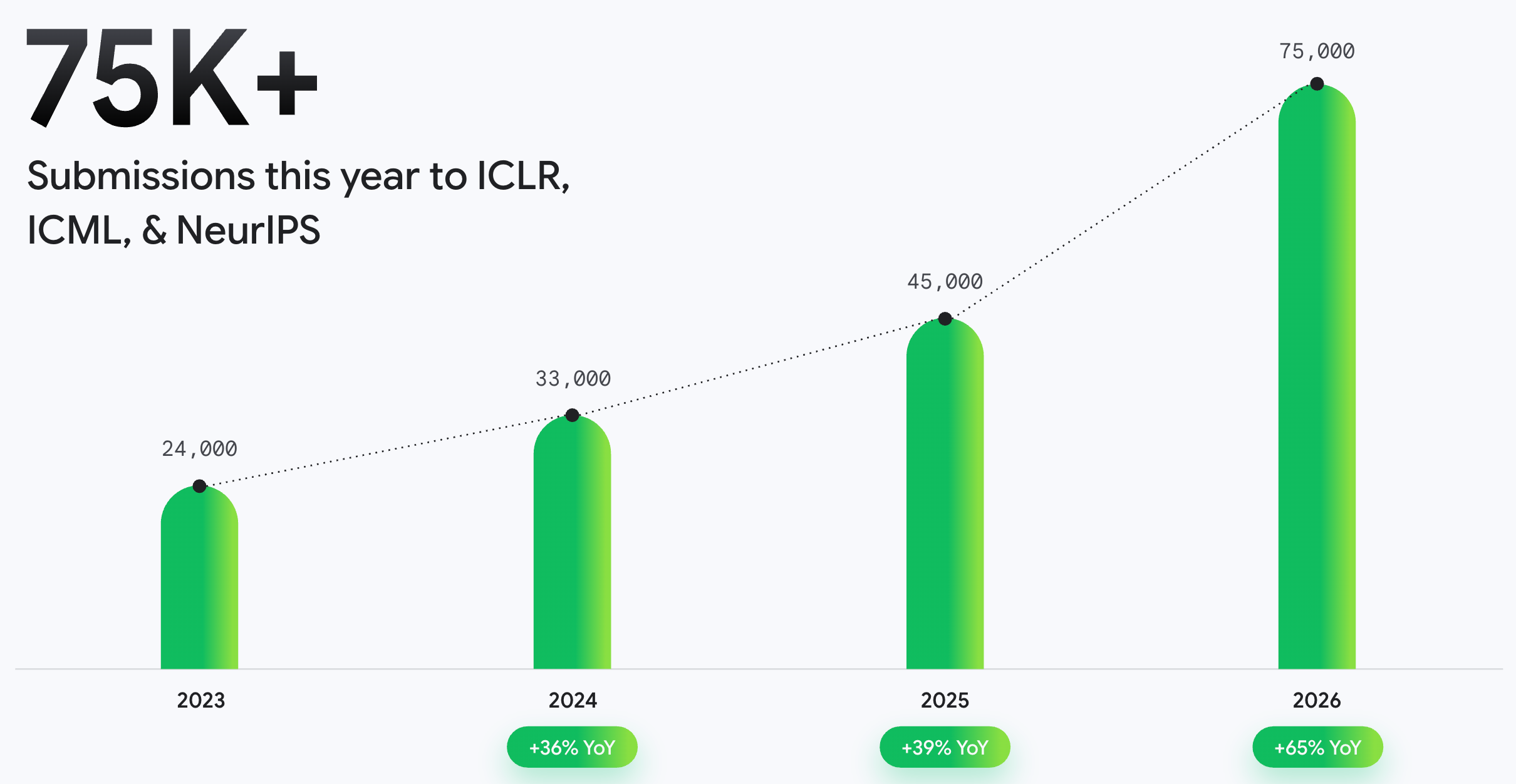
Behind the launch is a verification bottleneck. According to Google Research scientists Rajesh Jayaram and Vincent Cohen-Addad, who wrote the Deep Review announcement, submissions to three AI conferences, ICLR, NeurIPS and ICML, topped 74,000 this year. That is up from about 23,000 in 2023, 32,000 in 2024 and 45,000 in 2025. According to the official ICML 2026 fact sheet, which METAL reviewed, the main track of ICML 2026, held in July at COEX in Seoul, alone received 24,661 submissions and accepted 6,552. Google's diagnosis is that AI has sped up the writing of papers while the number of people available to check them has barely changed.
Deep Review works in four stages. A segmenter agent divides the document into logical sections such as the introduction, methods and experiments, and assigns each section a different compute budget based on its information density. Sections dense with proofs get more compute than an introduction. Specialized reasoning agents then verify their assigned sections in parallel while keeping the full document in context, and a synthesis agent finally consolidates the section reports, rechecks for contradictions between sections and filters out hallucinations through external grounding checks.
Its track record was built at conferences. Over the past year, its predecessor, the Paper Assistant Tool (PAT), partnered with STOC 2026, ICML 2026, NeurIPS 2026 and ICLR 2027 to give authors who opted in private feedback before submission. The feedback was fully separate from the conferences' official review, manuscripts were not used for training, and they were deleted as soon as each program ended. The public version, built on Gemini 4 Argon, extends review to legal contracts, financial reports, design documents and presentations. Every user gets two free document reviews a week, and heavier users can connect a Gemini API key. Uploaded documents are not used to train Google models and are kept for one year only for display.
The other highlights are tools that take work off researchers' hands. The Geospatial Reasoning agent in Google Earth AI is widening access through a trial agent-to-agent API. METAL reported that Google Research released public health case studies for geospatial AI. In the new technical report, at the start of the 2026 Ebola outbreak in the Democratic Republic of the Congo, the World Health Organization's Regional Office for Africa used the agent to overlay satellite forest loss, mining sites and population data, finding 48 high-exposure settlements and more than 45,500 at-risk people within minutes. The work usually took weeks. Dr Etien Koua, hub coordinator for WHO AFRO Emergency Preparedness and Response, said "Mobile populations like miners move faster than traditional paper surveillance can track," adding that "Earth AI fills those gaps with satellite and mobility signals." Google.org is providing $10 million to crisis resilience and public health organizations, including $2 million for the Milken Institute.
In health, two studies came out. The open medical model MedGemma was published in Nature Medicine last week and has been downloaded more than 10 million times by more than 65,000 developers. In a new study in The Lancet, the conversational diagnostic AI AMIE safely consulted 98 patients at Beth Israel Deaconess Medical Center ahead of urgent care visits, and clinicians said the AI summaries helped them prepare in 75% of cases. Groundsource, a disaster prediction methodology, used Gemini to analyze flood news reports and build a dataset of more than 2.6 million flood events, and a new model trained on it predicts the likelihood of urban flash flooding up to 24 hours ahead. Google's riverine flood forecasts cover more than 2 billion people in over 150 countries up to seven days in advance.
The remaining strands also came with numbers. The time-series foundation model TimesFM and the tabular data model TabFM are set to come to Gemini for business, and Synaptics will unveil next week a low-power edge AI chip co-designed using Google's open-source IP. A pilot of learning interactives, which let teachers build science and math simulations matched to their curriculum, includes more than 30 AI-generated simulations vetted by teachers. Yossi Matias, Google VP and head of Google Research, said "This is the golden age of research and scientific discovery," adding that "Today, more than ever, we can push the frontiers and ask the most audacious questions that can have transformative impact on products, science, and society."
Seen through a sociologist's eyes, the center of this announcement is not a flashy model but a redistribution of verification labor. Peer review has long favored authors with senior faculty, large labs and wide advisory networks. Google says Deep Review opens pre-submission critique to researchers without such networks. Deep Review takes on the heaviest cognitive work, such as logical consistency and factual grounding, while leaving creative direction and final judgment to people. The Earth AI technical report likewise defines the agent's output as a first draft for experts to review, not a final answer. Research@'s conclusion is that the gap between how fast AI produces manuscripts and how fast people can check them should be closed with the same AI, and its success depends on how much researchers trust that first draft, and how much they doubt it.




Comments