


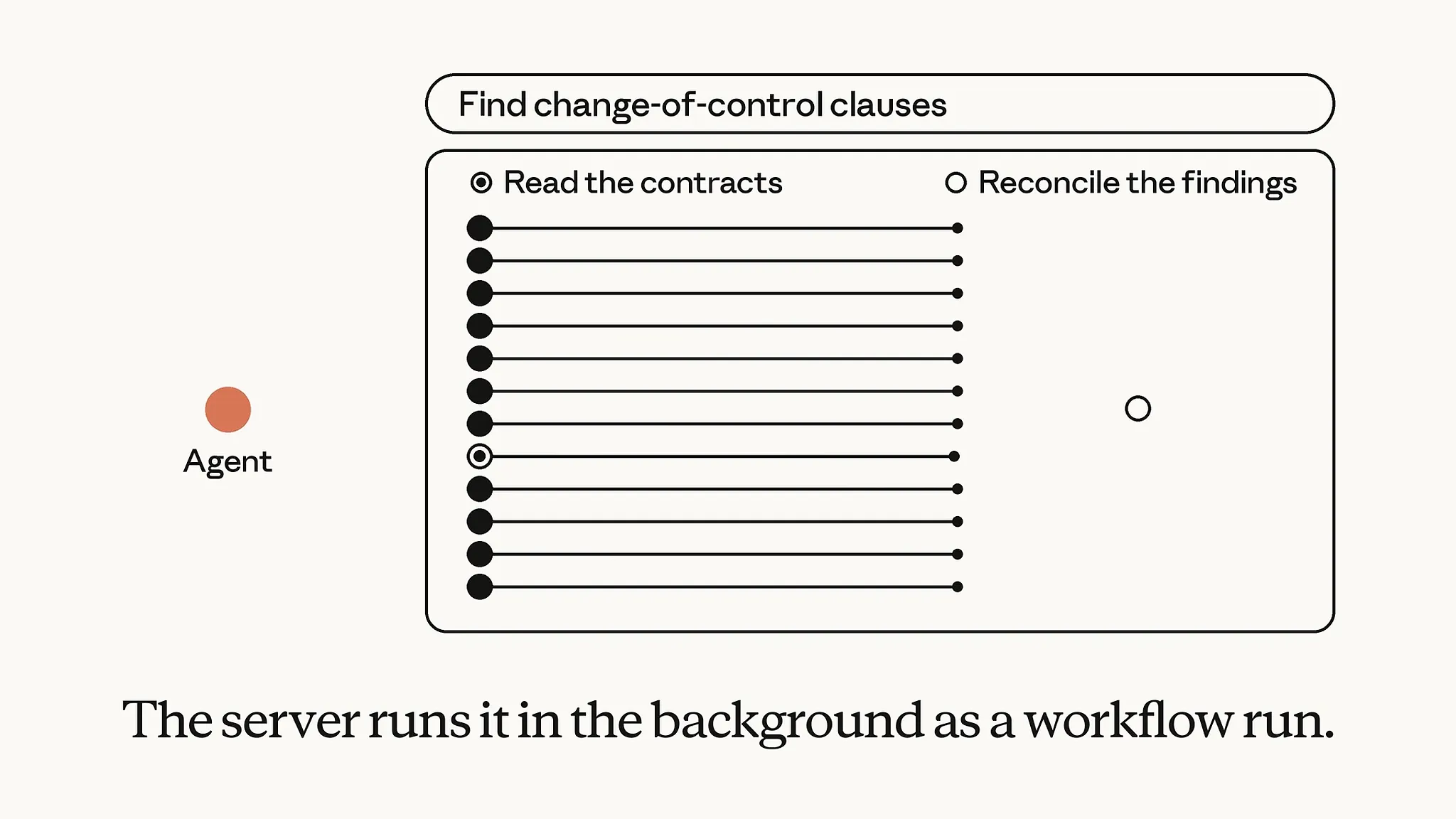
Image: @ClaudeDevs (X) (video still)
Summary
- On October 9, Anthropic released dynamic workflows for Claude Managed Agents as a public beta.
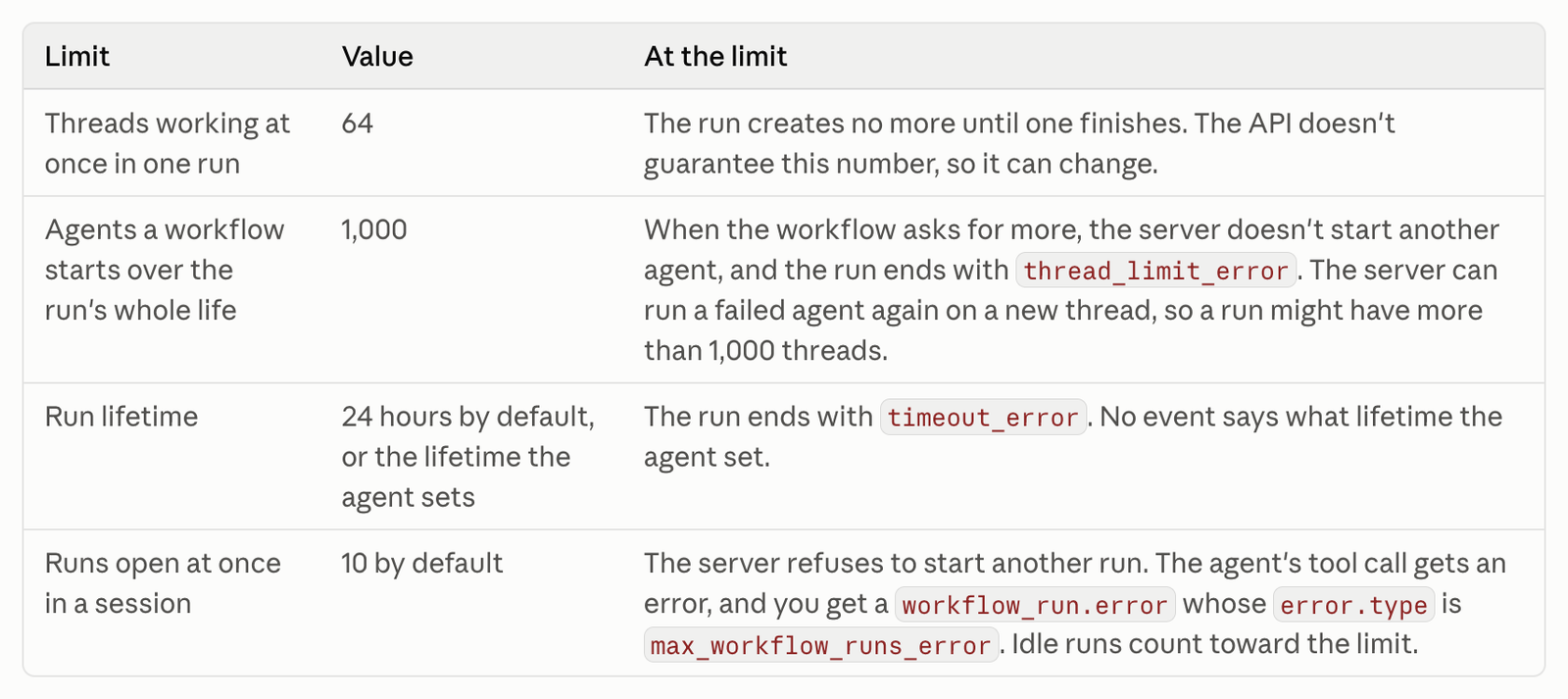
- The server runs the agent-written program in the background, and a single run is capped at 64 concurrent threads, 1,000 agents in total and a default lifetime of 24 hours.
- Runs carry no separate price; the tokens their agents use are billed at each model's rates, and every open run pauses when the session reaches its budget.
Anthropic has opened dynamic workflows in Claude Managed Agents, its hosted agent service for businesses, as a public beta. The company's developer account @ClaudeDevs introduced the feature on X on October 9 as "a new type of multiagent orchestration, built for your most ambitious workloads." A lead agent writes its plan as a program, and that plan runs many agents in phases before combining the results at the end. The post passed 360,000 views in less than a day.
The core change is who directs the work. In its platform documentation, Anthropic defines a workflow as "a program that an agent writes to run many agents and combine what they return." Under the existing subagent approach, the lead agent hands out work turn by turn and reads the reports itself. With dynamic workflows, the program the agent wrote decides which agents run next and even writes their prompts. Each agent's result goes to the program, not to the lead agent. While the server executes that program in the background as a single workflow run, the lead agent can keep talking with the user or end its turn.
A run is divided into phases and agent threads. A phase is a named stage of work such as "Read the contracts," and within each phase the program launches many agents at once. Every agent works in its own session thread, and all threads share the same files in the session's sandbox. The program can also have a draft revised until a review passes, or handle a failed agent separately. An agent can be an inline agent that the workflow defines on the spot, or one the developer registered in advance. Inline agents use the same model as the session agent and receive tools and MCP servers from within what the session agent already has.
The documentation's example is a set of 300 contracts. When a user asks which contracts contain a change-of-control clause, the agent starts a two-phase run, "Read the contracts" and "Reconcile the findings," and when the run ends it answers that 41 of the 300 have one. The 58-second official introduction video that METAL reviewed shows the same scene: the agent faces 300 contracts, writes a workflow, and the server runs it in the background before returning the combined result.
Scale comes with numerical limits. Up to 64 threads can work at once within a run, and a run can start 1,000 agents over its whole life. Beyond that, the run ends with thread_limit_error. A run's lifetime is 24 hours by default, and the agent can set a shorter one. A session can keep 10 runs open at once by default. Only the agent on the session's primary thread can start a run, so agents inside a run cannot open runs of their own.
The cost structure is also documented. A run has no price of its own, and the tokens its agents use are billed at each model's rates like the session's other tokens. When the session reaches its budget, every open run pauses, and raising or removing the budget resumes them. Each thread still finishes the model request it already sent, so a run can pass the budget by one request per working thread. According to reports, Managed Agents runtime is billed at $0.08 per session-hour in the running state, and web searches cost $10 per 1,000. The documentation also says a run ending as completed does not mean the work passed. Failed work can only be found by reading each thread's events.
A feature with the same name existed first in Claude Code. According to Anthropic's cookbook, Claude Code's dynamic workflows have Claude write a JavaScript orchestration script and pass it to the Workflow tool, while the local runtime runs up to 16 agents concurrently and caps a run at 1,000 agents. The cookbook ran an example that checks 10 claims in a draft investor update against source data in 2.5 minutes for $3.29, and, on catching a subtle misquotation, wrote: "That precision comes from the structure of the workflow rather than from a smarter model." This public beta moves that approach from a developer's laptop onto Anthropic's servers.
What developers need to do is turn on the workflows setting in the multiagent block of the agent definition. According to reports, the feature is enabled with the managed-agents-2026-04-01 beta header and the multiagent_20261001 type, under which workflows and subagents are enabled by default. The agent still decides when to start a run, so the prompt should spell out when to use one. The workflow code itself is not visible to developers; they have to ask the agent to see it.
METAL previously reported on how three founders use Claude Managed Agents. This public beta widens the unit a single session can direct from a few agents to hundreds. A program on the server splits up the review of hundreds of documents that would not fit in one conversation, and people check the results together with the bill. The question that remains is whether an answer produced by 1,000 agents is proportionally more accurate than one agent's answer, and who measures that difference, and how.
Sources
- Anthropic (@ClaudeDevs on X) — Claude Managed Agents dynamic workflows are now available in public beta →
- Anthropic — Workflow runs - Claude Platform Docs →
- Anthropic (Claude Cookbook) — Orchestrate subagents at scale with dynamic workflows →
- Kingy AI — Claude Dynamic Workflows Beta: Can It Beat One Agent? →



Comments