


Summary
- Google Research has released TimesFM-3, a foundation model that takes in multiple time series at once to forecast the future.
- The 330-million-parameter model was pretrained on more than a trillion time-series data points and topped all three benchmarks — Gift-Eval, FEV-Bench, and Time.
- The model is available now on GitHub and Hugging Face, with BigQuery AI.FORECAST integration set to follow within weeks.
 Why multivariate forecasting was needed
Google Research has released TimesFM-3, a foundation model for multivariate time-series forecasting, on GitHub and the TimesFM-3 model page on Hugging Face. The model takes in several data streams at once and produces future values in a single pass, and it's built for the kind of forecasting work that comes up in retail, finance, and healthcare.


Put simply, AI time-series forecasting models up to now looked at a single data stream — sales, foot traffic, whatever it might be — to predict what comes next. But in an actual store, you also need to feed in information that's already known about the future, like a scheduled promotion or the sales volume of related products, to get an accurate forecast. TimesFM-3 is built to take in several of these data streams at once and calculate how they influence each other.
Real-world problems like sales or foot traffic are almost always shaped by multiple signals at the same time — related product sales, promotion schedules, weather forecasts — and univariate models simply had no way to account for any of that.
The gap, illustrated with ice cream sales
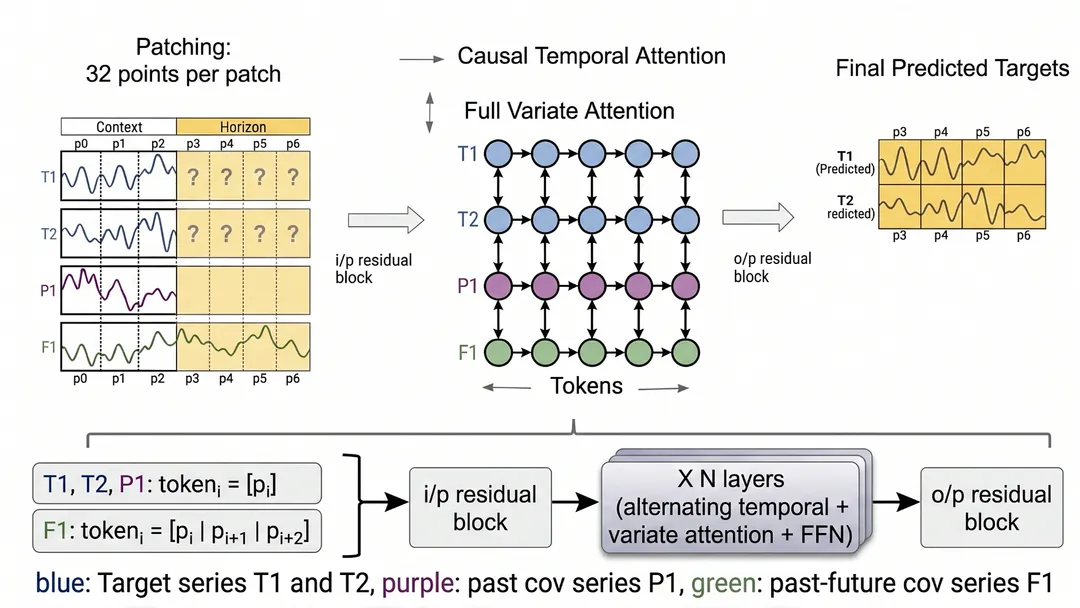
Google Research used ice cream sales forecasting as an example. A conventional univariate model that only looks at past sales records just extends the day-of-week pattern into the future, missing any promotion planned for a specific date. TimesFM-3, by contrast, takes the promotion schedule in as a "past-future covariate" — a signal already known about the future — and learns the relationship between promotions and sales spikes from historical data, then applies that relationship to future promotion dates. Google Research says the result was a forecast of roughly a 20% sales jump on every promotion day.
330 million parameters, one forward pass
Like its predecessors, TimesFM-3 uses a decoder-only transformer architecture, but it groups 32 time steps into a single patch and runs those patches through a two-dimensional attention structure that moves across both the time axis and the axis relating different time series to each other.
For past-future covariates, the model applies a "look-ahead" strategy, designed so each token bundles together the current patch and future patches. The forecasting approach has changed too. Earlier versions generated patches one at a time in sequence, which meant latency and accumulating errors piled up. TimesFM-3 draws on research applying a Contiguous Patch Masking technique, masking out the entire future window and filling in all the predicted values at once in a single forward pass. For each time point, it also outputs nine quantiles spanning the 10th to 90th percentile, giving a sense of the uncertainty range around each forecast.

First place across three benchmarks
Google Research evaluated TimesFM-3 on three benchmarks: Gift-Eval, FEV-Bench, and Time. Compared against multivariate-capable models like Chronos-2 and the Toto 2.0 family, as well as its own predecessor TimesFM-2.5, TimesFM-3 ranked highest among pretrained foundation models on all three benchmarks, on both point-forecast and probabilistic-forecast metrics.
| Evaluation mode | Benchmarks | Result |
|---|---|---|
| Univariate mode (evaluated without covariates) | Gift-Eval, FEV-Bench, Time | On par with or ahead of other foundation models |
| Multivariate mode (using covariates) | Gift-Eval, FEV-Bench, Time | First place on both point and probabilistic metrics |
Even in univariate mode — evaluating each time series on its own, without covariate information — TimesFM-3 matched or beat competing models, and Google Research says switching to multivariate mode pushed its ranking up a further notch.
How to try it
Where to start — TimesFM-3 checkpoints are available from the GitHub repository and the TimesFM-3 model page on Hugging Face.
Step-by-step usage
- Download the TimesFM-3 PyTorch checkpoint from Hugging Face or GitHub.
- Prepare your target time series (say, sales), along with past covariates like related product sales, and future-known covariates like a promotion schedule.
- Feed this data into the model together, and it returns the entire forecast window along with nine quantiles in a single forward pass, no iteration needed.
Who can use it — Loading the model directly through code is a path suited to teams with development chops. If you want to try time-series forecasting without ML expertise, you can already use the earlier model, TimesFM-2.5, for univariate forecasting right now through BigQuery's AI.FORECAST command.
What you can try — A retail chain could feed in promotion schedules alongside inventory data to get an early read on sales spikes during discount periods. A manufacturer could use equipment operating schedules and raw-material delivery timing as covariates to forecast production volume swings. In observability, you could feed in multiple server metrics at once to see how an anomaly signal in one metric ripples into the others.
Editor's take
The original idea, much like with image or language models, was a single pretrained model that could forecast time series across multiple domains without any additional tuning. Two years on, Google has pushed that model from univariate to multivariate, moving it much closer to problems that look like the real world. That shift is also setting up a head-to-head on Salesforce's Gift-Eval benchmark, where TimesFM-3 is now measured against other multivariate models like Chronos-2 and Toto 2.0 on the same terms.
Put a time-series model of this size into real deployment and you tend to land on the same conclusion every time — univariate models are good at capturing repeating patterns like seasonality or day-of-week effects, but accuracy falls off a cliff the moment something gives the data "a reason to move differently this time," like a promotion or a holiday. TimesFM-3's choice to accept covariates as input reads as a direct answer to exactly that weak spot.
What's worth noting for Korean retail and manufacturing companies is that the model is open source, so it can be validated against proprietary data without a separate contract. That said, BigQuery integration hasn't been extended to TimesFM-3 yet, so teams that want to run it with a single command straight from the cloud console are probably better off experimenting with TimesFM-2.5 for now while getting their data pipelines ready.
Once BigQuery's AI.FORECAST command starts supporting TimesFM-3 in the coming weeks, the barrier will drop another notch — letting data teams that don't work directly in code start experimenting with multivariate forecasting too.
Sources
- Google Research Blog — TimesFM-3: A zero-shot foundation model for multivariate forecasting →
- Google Research — Introducing TimesFM-3, a state-of-the-art time series foundation model that enables accurate multivariate time series forecasting in a single forward pass, significantly outperforming other forecasting models across major benchmarks. →
- MarkTechPost — Google AI Releases TimesFM-3: A 330M Parameter Zero-Shot Foundation Model For Multivariate Time Series Forecasting →


Comments