



Image: METAL
Summary
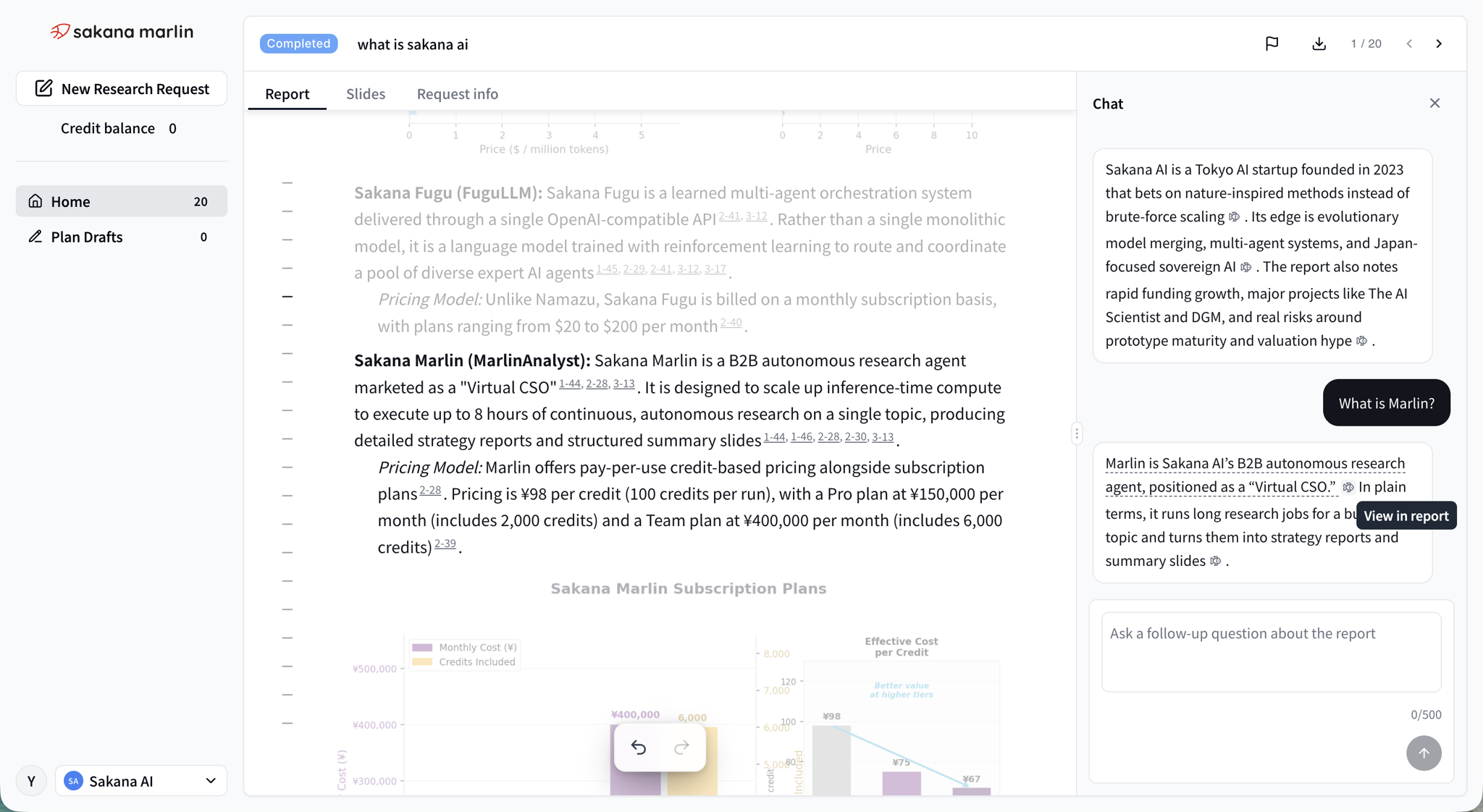
- Interactive Reading lets users question the agent in a chat about a report, and clicking a citation has the AI open the source and show the passage the statement rests on.
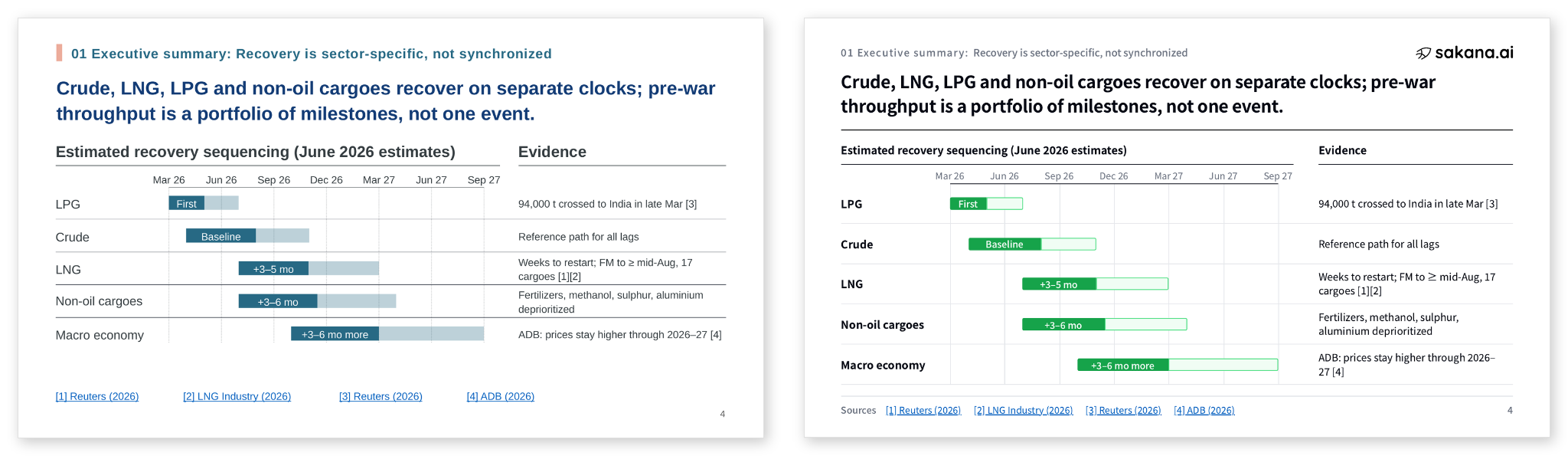
- PowerPoint export lets users edit the data and formatting of tables and charts, carries source URLs on every slide, and works with any template.
- The company cited user feedback that the new bottleneck is not the research itself but understanding, confirming and communicating the results.
Sakana AI announced an update on September 16 that adds two features to its research agent Sakana Marlin. One is Interactive Reading, which lets a reader question a statement in a report on the spot and check its evidence; the other is slide export, which turns research findings into an editable PowerPoint file. The company posted the same announcement in Japanese and English on its blog and shared it from its official X account. Both features, the company said, exist to help the people reading the dozens of pages Marlin produces understand them properly and turn that understanding into better decisions.
Sakana Marlin launched in June this year. According to the announcement, its concept fits in one line: "leave the research to AI, so people can focus on the decision making." Using the company's own AB-MCTS technology, it runs research sessions of up to eight hours, working autonomously from framing a hypothesis through gathering information to writing up the findings as a report. The company wrote that the thinking behind it was that the world has been changing noticeably faster since generative AI arrived and the volume of information to process keeps growing by the day. Since launch, it said, large enterprises, startups, consulting firms, financial institutions, and universities and research institutes have used it for their research work.
The starting point for this update is a problem the company did not anticipate at launch. Watching users work with Marlin in real jobs, Sakana AI wrote in the announcement, it realized the bottleneck had moved. It was no longer the research but the process of understanding: people reading the findings, judging how sound they are, and coming to believe the conclusion. The announcement reproduces three pieces of user feedback. One user said, "The coverage is impressive, but working through dozens of pages of findings is hard going, and in the end I am not spending much less time on research than before."
The other two point the same way. One user said that, as when reviewing a colleague's work, they wanted to trace claims back to the source to check how sound they were, but had no way to ask the AI what a given interpretation was based on. Another said that before sharing or presenting internally they wanted to revise the report and fold in their own reading, but the interactive tools to do so were missing. From this the company drew its conclusion: however much AI cuts the time and effort of research, the steps just before a decision, where a person understands, confirms and communicates the material, remain a bottleneck.
The first feature, Interactive Reading, aims straight at that bottleneck. According to the announcement, users can discuss the output report with the agent in a chat or ask questions, and because the agent takes them straight to the relevant part of the report, they can focus on what they want to dig into instead of reading from the top. Click a citation inside the report and the AI agent opens the source and points to the passage the statement rests on. Finding that passage on the source page used to be the user's job; in the new Marlin, the company explained, the AI does that work together with the user.
The company drew one line while explaining the feature. When working from an AI-generated report, verifying everything yourself defeats the purpose of handing the research to AI, while accepting it all without checking means the judgment is not really yours. The announcement describes Interactive Reading as the feature that removes that trade-off. The company wrote, "Exploring alongside the agent and questioning as you go is what turns an AI-generated report into your own understanding," adding that the quality of human decisions rests on this conversion from information into understanding.
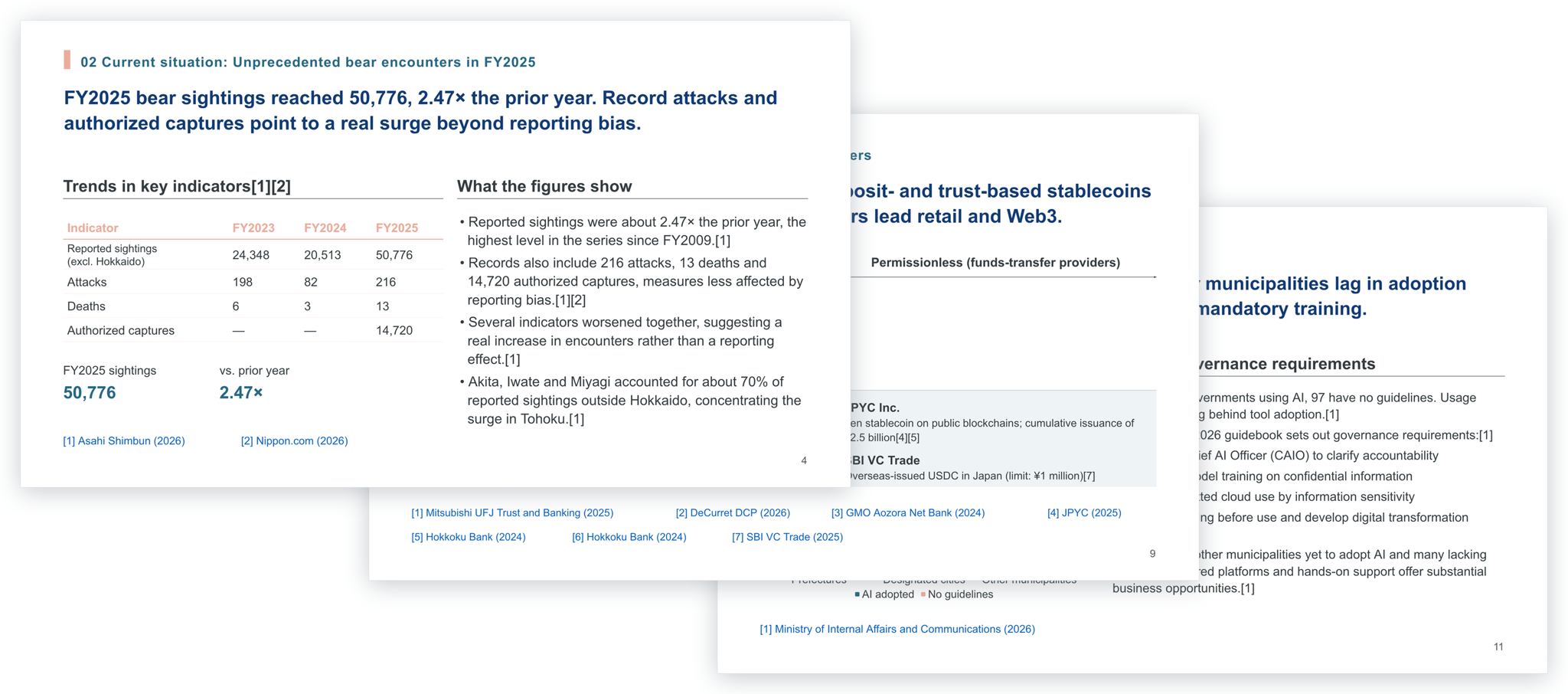
The second feature is export to editable PowerPoint files. Exporting Marlin's findings as slides lets users change not only the text and shapes but also the data and formatting of tables and charts. Every slide carries the source URLs, so the evidence can be checked directly from the deck. Because export works with any slide template, the company said, using an internal template or one specified by a client cuts down the tidying that would otherwise follow. It added that which parts of the findings to focus on, what to select from them to pass on, and what discussion to steer them into is a process in which the user's own experience and judgment show.
The Marlin product page that METAL reviewed introduces the agent as a virtual chief strategy officer. It takes on the kind of strategy research a chief strategy officer and a small team might otherwise spend weeks on, and instead of generating text in seconds it focuses on long-horizon reasoning, spending up to eight hours forming hypotheses, gathering information, navigating the web and resolving contradictions on its own. The page notes that its exploration engine AB-MCTS was a NeurIPS 2025 spotlight and that The AI Scientist, the root of its autonomous workflow, was featured in Nature. As samples, reports and slide decks on three topics are posted as PDF and PPTX: resolution scenarios for a Strait of Hormuz blockade, the global AI regulation patchwork, and the return of the bond vigilantes.
The same page also marks the boundaries of its use. Marlin suits strategic planning, market and competitor analysis, technology trend evaluation and regulatory research that validates hypotheses against aggregated public data, and the company says it is currently not suited to niche sectors with minimal public data, use cases requiring split-second real-time tracking, or research that relies entirely on internal private data. It is a B2B service for corporations, organizations and sole proprietors rather than general consumers, and while it is available outside Japan, the company does not provide it to users in EU or EEA member states. The page states that input data is not used to train models by Sakana AI or its external AI providers unless the user explicitly opts in.
Sakana AI has been releasing product news in quick succession over the past two months. METAL has reported that Sakana AI released two orchestration models that choose which model to use, and has examined the structure of the company that a Transformer paper author founded in Tokyo. The Marlin update is the first announcement in that run to work on the reader rather than the model.
The company gave a name to where this update is headed. It is not enough to produce a trustworthy report; people should be able to follow it, confirm it and be convinced before they judge, thinking, understanding and deciding together with AI rather than treating it as a capable black box. Sakana AI calls this two-way relationship between people and AI attunement, and wrote in the announcement that this update is a step toward it. Marlin is available on a pay-as-you-go plan from the same day a credit card is registered, and a free trial is also available, the company said. Sakana AI has moved its product from an AI that does the research for you to an AI that prepares the decision with you.


Comments