


Summary
- On September 24 Google Research unveiled a long-form AI video generation framework that combines Co-Director, CANVAS, A²RD and VQQA.
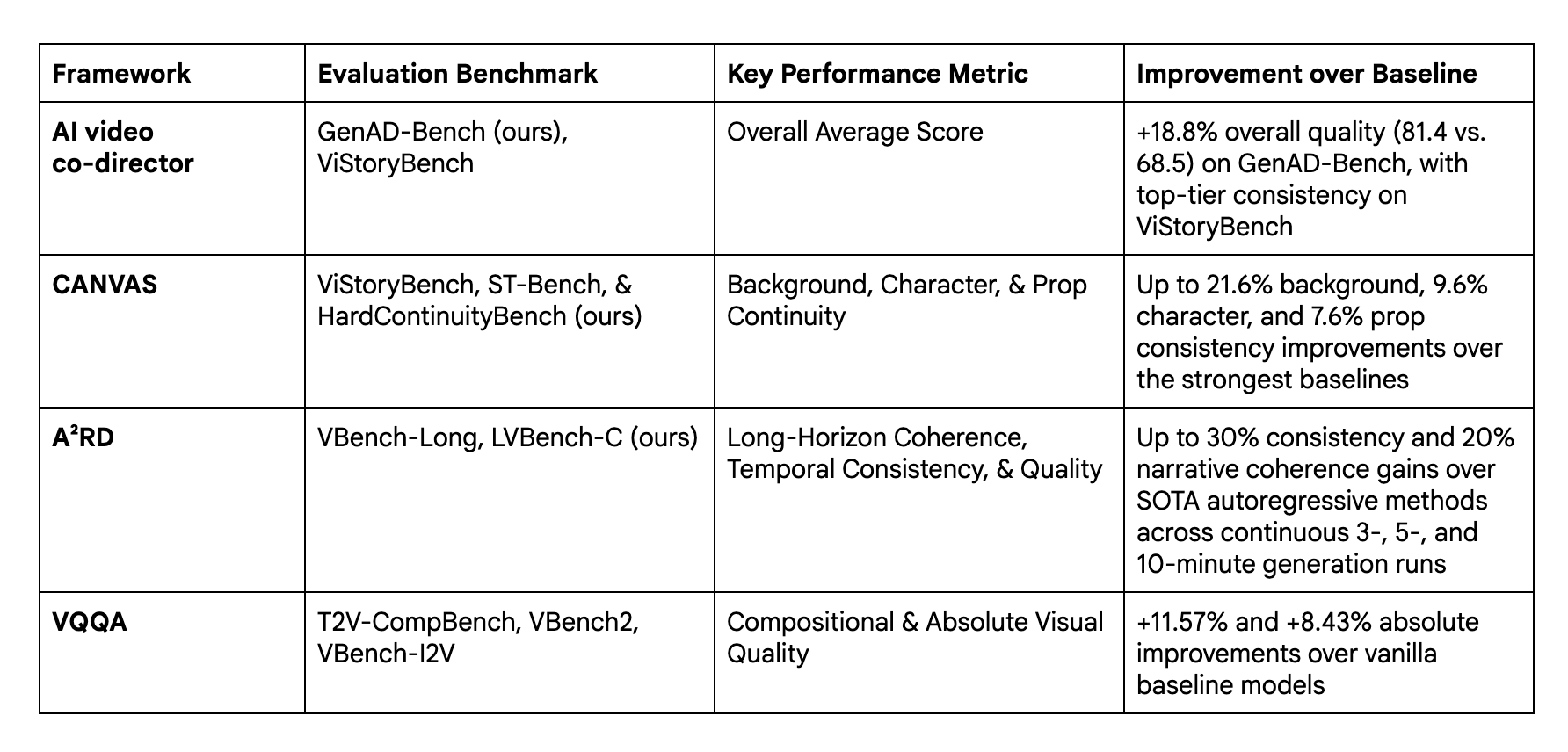
- CANVAS reported a 21.6% gain in background continuity, A²RD up to 30% in consistency and VQQA 11.57% on T2V-CompBench.
- The researchers also released a ten-minute film, and every output carries a SynthID watermark.
On September 24 Google Research unveiled research on a long-form AI video generation framework that plans, shoots and fixes minutes-long videos on its own. It is called the AI video co-director and is built as an orchestration layer on top of Gemini and Veo. The researchers bundled four frameworks into one: Co-Director, which sets the story direction; CANVAS, which keeps storyboards continuous; A²RD, which stitches long videos together segment by segment; and VQQA, which finds defects and rewrites prompts. Co-Director is set to appear at COLM 2026 and CANVAS at EMNLP 2026.
The problem the researchers set out to solve was not a clip of a few seconds but a story. Diffusion models can render high-fidelity scenes in seconds, but when several cuts are chained together, semantic drift creeps in as a character's clothes or the background change little by little, and cascading failures occur when a small upstream error ruins the entire downstream video. The blog describes this as the classical credit assignment problem, in which it is hard to trace a failure that surfaces at the end back to a specific prompt. As a result, the process today demands endless manual fixes.
The first stage, Co-Director, turns video making into a global optimization problem. An Orchestrator Agent uses a multi-armed bandit algorithm to pick a combination across three dimensions, creative strategy, narrative mode and aesthetic archetype, and a Pre-Production Agent bundles the storyline and visual assets into a storyboard. Under the Production Agent, keyframe, video and audio agents handle characters and scenes, motion, and voiceover and score respectively. A multimodal model judge scores the finished cut along the three dimensions and feeds the result back to the algorithm, and this loop runs several times to refine the choices.
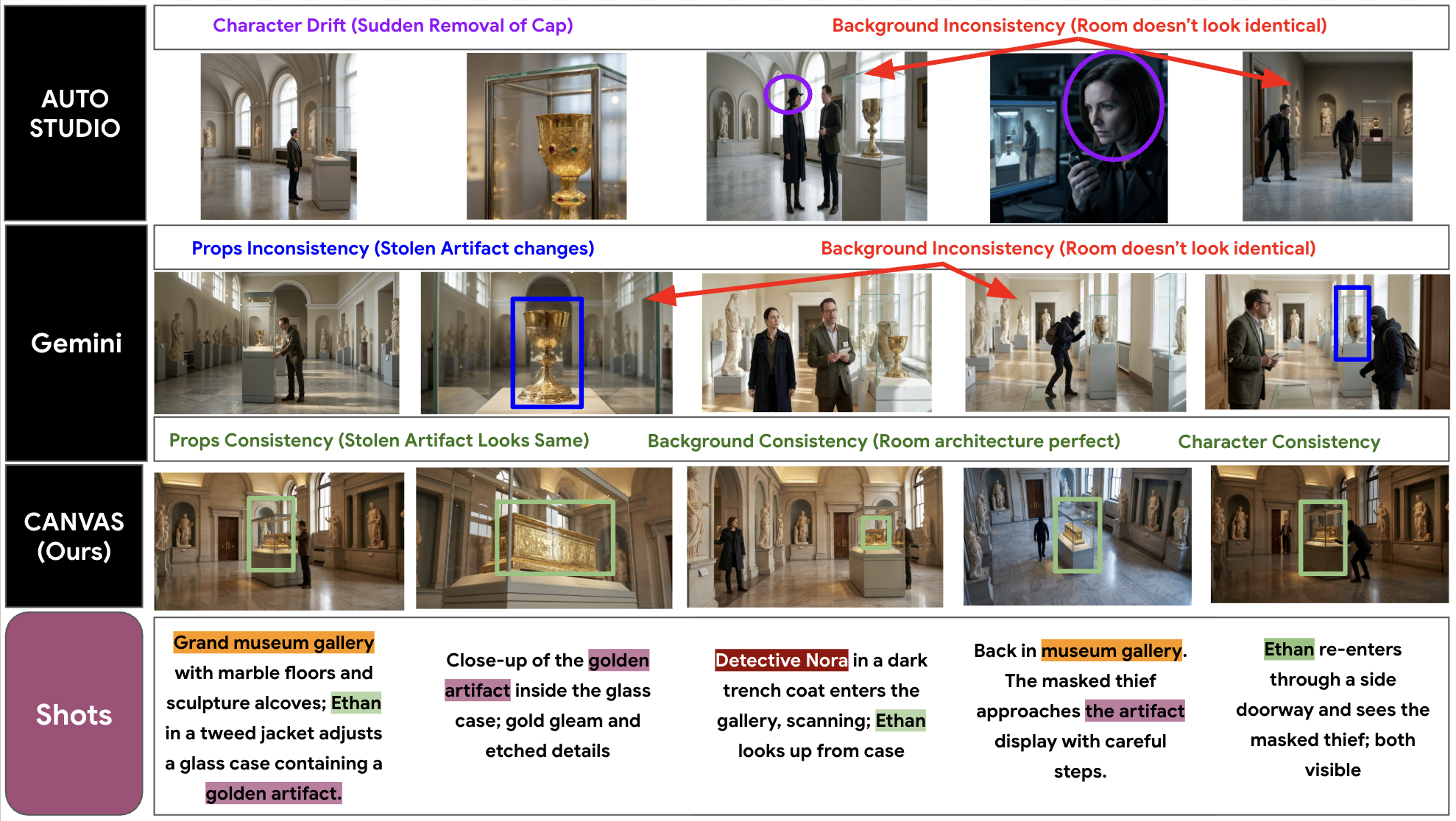
The second, CANVAS, keeps a visual memory that records the state of characters, locations and props. In the museum heist scene shown on the blog, generation with Gemini 3.1 Pro alone changed the gemstone and let the exhibit hall layout shift, while AutoStudio, another multi-agent framework, lost the thief's cap as the cuts moved on. According to the paper, CANVAS improved background continuity by 21.6%, character consistency by 9.6% and prop consistency by 7.6% over the strongest baseline. To measure this, the researchers even built a new benchmark, HardContinuityBench, from multi-shot storyboards made with GPT-5.2.
The third, A²RD, turns storyboards into actual minutes-long video. For each segment it runs a loop that retrieves memory, synthesizes, refines and updates the record, choosing extrapolation to push the story forward and interpolation to anchor returning characters and places to their original look. The researchers released a ten-minute film made this way. The paper says that on videos from one to ten minutes long it beat the best existing methods by up to 30% in consistency and up to 20% in narrative coherence. The evaluation set LVBench-C has 120 scenarios and imposes a rule that key assets must disappear for at least 10 segments before returning, changed to fit the story.
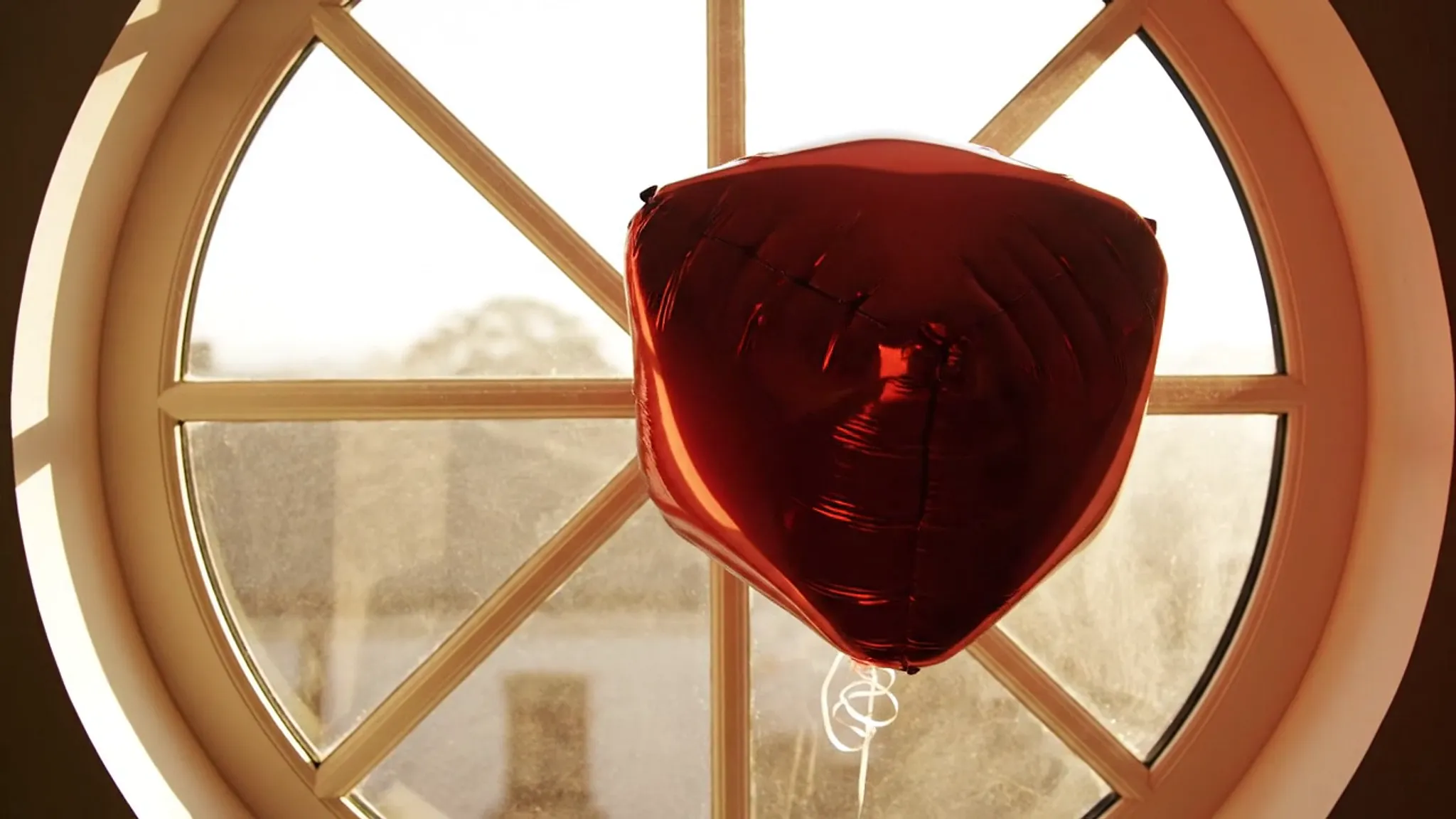
The last, VQQA, fixes the words rather than painting over the picture. It generates visual questions tailored to the prompt and uses a vision language model's critiques like semantic gradients that point in a direction, rewriting the prompt. At the end of the iterations a global selection mechanism rescores every candidate against the original prompt and picks the highest-scoring video. In an eight-second comparison video on the blog that METAL reviewed, the vanilla generation drew a cuboid balloon drifting past a round window as a rigid red box, while the VQQA version drew a foil balloon with visible seams. On the paper's numbers that is an absolute improvement of 11.57% on T2V-CompBench and 8.43% on VBench2.
The advertising task produced numbers too. Using Gemini 3 Pro and image models, the researchers created 50 fictional brands with four products each and assembled GenAD-Bench with 400 scenarios. The design checks whether marketing constraints are met without relying on copyright conflicts or memories in training data. According to the evaluation table on the blog, Co-Director scored 81.4 on this benchmark, 18.8% higher in overall quality than the baseline's 68.5. Sixteen researchers are listed on the Co-Director paper.
Safety mechanisms are inherited from the base models. Because every image, video and audio track passes through Gemini and Veo, the SynthID watermark stays attached, and the researchers wrote that in production, classifiers can additionally be applied across the whole finished video to catch unexpected context that arises when individually safe clips are joined. The structure itself is not tied to a particular model and can sit on top of other generative models. METAL has reported on MiniMax H3, where video generation became faster than playback, and this research aims not at speed but at continuity that holds for minutes.
Through a sociologist's lens, what this research shifts is the division of labor in directing. The job long done by a film set's script supervisor, checking clothes, props and blocking cut by cut, would go to a memory system and a judge model, leaving people only with deciding what story to tell. The paper authors, Google research scientists Yale Song and Yiwen Song, wrote that they designed the framework as "responsive creative partners that abstract away the burdens of maintaining visual continuity, freeing users to concentrate on the art of storytelling." The two said "our ultimate goal is not to replace human storytelling but to empower creators." As a next step the researchers said they will add workflows in which people step in along the way. The more continuity management passes to machines, the more a video's authorship will come down to who set its creative direction.
Sources
- Google Research — Automating coherent long-form video generation →
- arXiv — Co-Director: Agentic Generative Video Storytelling →
- arXiv — CANVAS: Continuity-Aware Narratives via Visual Agentic Storyboarding →
- arXiv — A²RD: Agentic Autoregressive Diffusion for Long Video Consistency →
- arXiv — VQQA: An Agentic Approach for Video Evaluation and Quality Improvement →

Comments