



Image: METAL
Summary
- On September 25, Anthropic opened a plugin submission portal for developers on paid Claude plans.
- Submissions go in as a single MCP connector or as a GitHub repository bundle, run through automatic validation and a safety scan, and once approved the developer decides when to publish.
- After launch the portal reports installs by product surface and version plus listing views and search terms, and Claude now supports MCP 2.0 along with the MCP Apps and Enterprise Managed Auth extensions.
Anthropic opened a submission portal for Claude plugins on September 25. It is the place where developers put their plugins into the Claude directory, see how far review has progressed, and check usage once the plugin is live. Any developer on a paid Claude plan can use it.
In its announcement, Anthropic called plugins the main way to build third-party extensions for Claude. A plugin is a package of MCP connectors, Agent Skills, or both. "Every day, millions of people connect Claude to their apps, work tools, and data," Anthropic said. "Today, we're making it easier for developers to reach them."
A post from Claude's official developer account on X the same day added a number. "Plugins package MCP and skills, and are becoming the way to build for Claude," the account wrote. "MCP usage across Claude products is up 110x this year." The post passed 540,000 views within a day.
There are two ways to submit. One is a single-connector submission that simply points to a remote MCP server. The other is a bundle: combine MCP servers and skills, host them in a GitHub repository, and submit that repo. Plugins meant for Claude Code can also carry LSPs, commands, hooks, and agents.
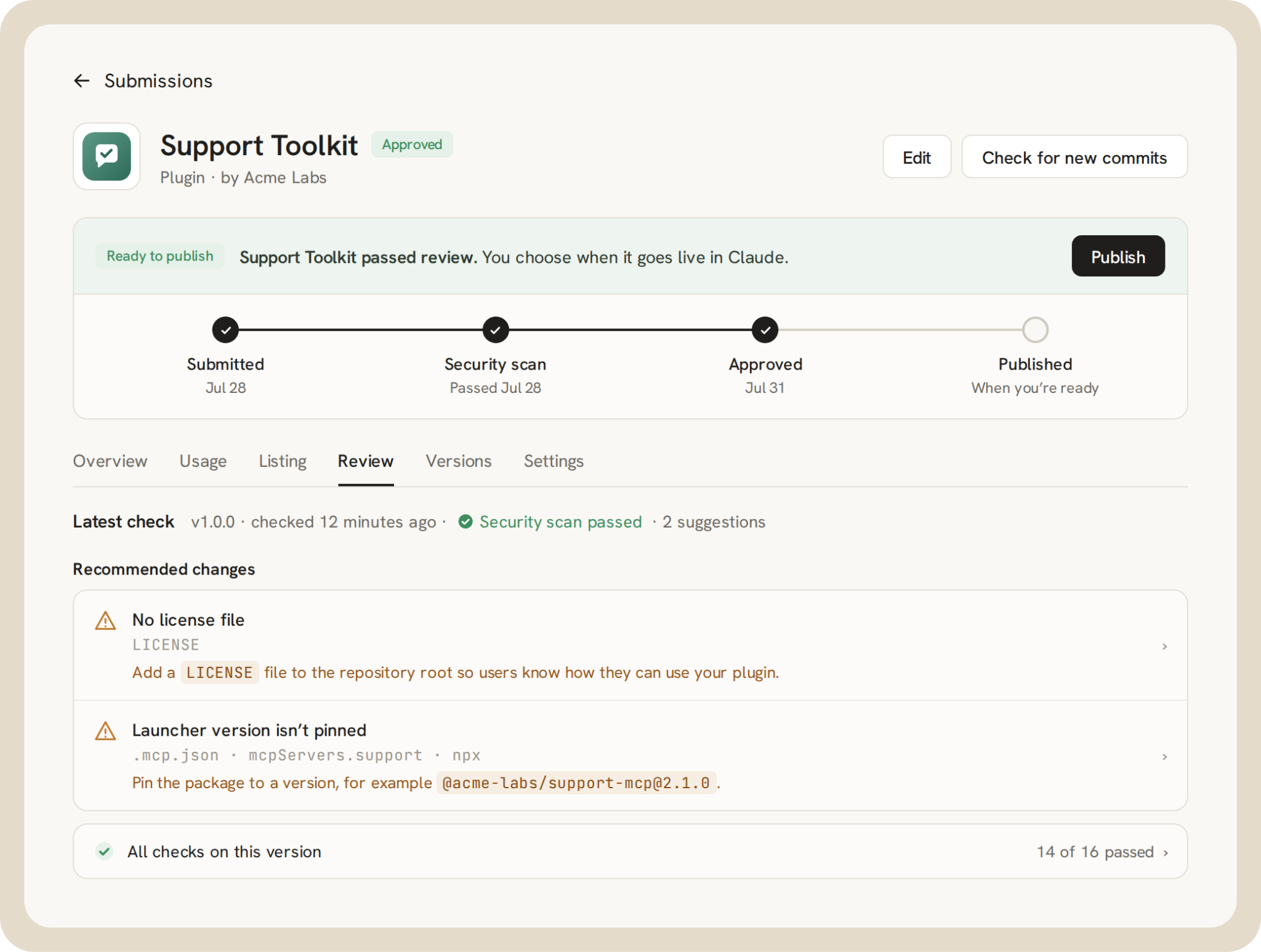
Review runs in three steps. Every submission is validated and safety-scanned the moment it arrives so problems surface early, and developers can see review progress, scan results, and recommended changes in the portal. Approval does not publish anything automatically; the developer picks the moment it goes live. According to reports, Anthropic's developer documentation says there is no partner program to apply to first and that every submission is checked before it is listed.
A sample screen in the announcement, which METAL reviewed, shows a fictional plugin that was submitted and passed its security scan on July 28, was approved on July 31, and is waiting only on the publish button. The recommended-changes panel flags a missing license file and suggests pinning the version of the MCP launcher package, and the screen reports 14 of 16 checks passed. Anthropic said the data on the screen is illustrative.
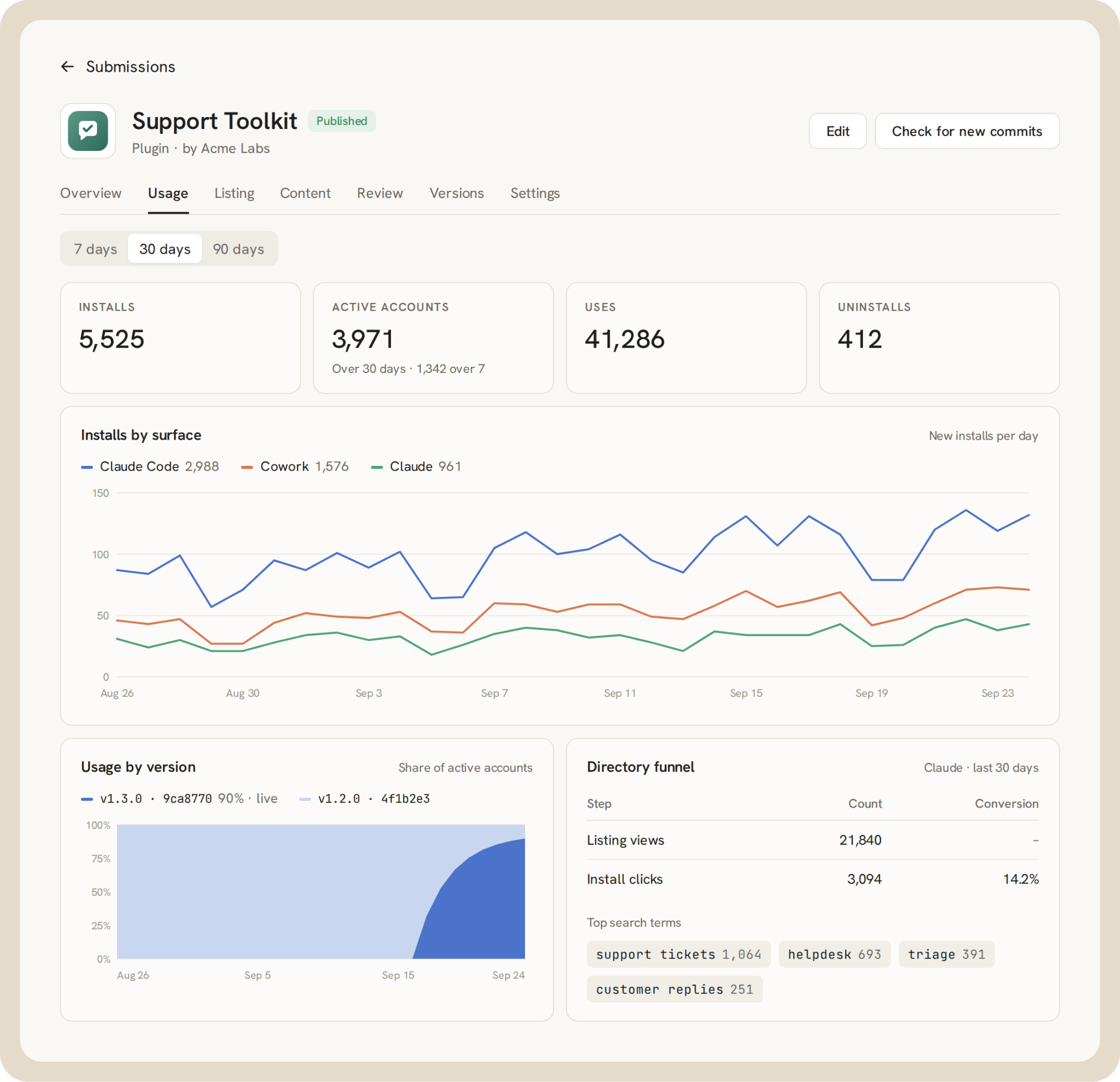
Numbers follow once a plugin is public. Usage analytics break installs down by product surface and by version, and discovery analytics show how often the listing is viewed and which searches bring people to it. The sample screen splits installs across Claude Code, Cowork, and Claude chat.
There was protocol news as well. Anthropic said Claude supports the latest MCP specification, commonly called MCP 2.0, whose defining feature is a stateless core. According to reports, the specification dated July 28, 2026 makes each request self-contained and negotiates capabilities per request. For a richer plugin experience Anthropic pointed to two extensions: MCP Apps, which puts interactive UI inside the chat, and Enterprise Managed Auth, which spares enterprise users a separate sign-in. METAL has previously covered the new MCP roadmap and its push toward stateless horizontal scaling and the general availability of enterprise-managed authentication for Claude's MCP connectors.
The portal pairs with an announcement from two days earlier. On September 23, Anthropic launched Claude Marketplace, a single place to find plugins, agents, and services from its partners, and according to reports it already listed more than 2,000 tools by the time the portal opened. Anthropic said a single discovery experience will roll out across Claude and Claude Code over the coming weeks. Skills and MCP connectors will keep their own listings, and developers will later be able to turn an existing connector listing into a plugin. Anyone who already has something in the directory does not need to change anything, Anthropic said.
Most of the tooling lives inside Claude Code, according to reports. The claude plugin validate command checks the manifest and component files, and claude plugin eval compares results with and without the plugin using eval cases the developer writes. Within a session, /skill-doctor reports how much context each installed skill consumes and how often Claude has called it. METAL has previously reported on Claude Code's eval feature that scores a plugin against a no-plugin baseline.
From an AI engineer's point of view, the weight of this release sits less in the review desk than in the instrumentation. Until now, plugin developers had no way of knowing who used their work or where once it shipped. Now a single screen shows whether installs come from Claude Code or chat, how quickly users moved to a new version, and which search terms turned into installs. An instant safety scan paired with a publish button in the developer's hands signals that, in an ecosystem where MCP usage is up 110x this year, Anthropic intends to move quality control from human hands into a pipeline. The teams that version their plugins like products and tune them against metrics are the ones likely to rise to the top of the directory.
Sources
- Anthropic — Build plugins for Claude with the directory submission portal →
- @ClaudeDevs (X) — It’s now easier to build plugins for Claude. →
- Unite.AI — Anthropic Opens Directory Submission Portal for Claude Plugins →
- Crypto Briefing — Anthropic announces Claude Marketplace as hub for plugins and connectors →




Comments