


Image: METAL
Summary
- book-to-skill, an open-source tool released by developer virgiliojr94 in May 2026, converts technical book PDFs or folders of documents into skills for AI agents.
- Based on measured results, it can answer the same questions using 24 to 51 times fewer tokens than loading the entire book into context.
- It runs on the open Agent Skills standard (SKILL.md) shared by GitHub Copilot CLI, Amp, and Claude Code.
Instead of reopening the book you bought and never finished, just ask
You buy a thick technical book, read it once, and three months later you can barely remember what was in chapter seven. Instead of flipping back through the table of contents every time that happens, there's now an open-source tool that lets you hand the whole book over to an AI agent and just ask it questions whenever you need to. It's in the book-to-skill repository on GitHub. Developer virgiliojr94 built book-to-skill in May 2026 as a converter that turns a technical book PDF, a folder of documents, or a bundle of reference materials into a single "agent skill."
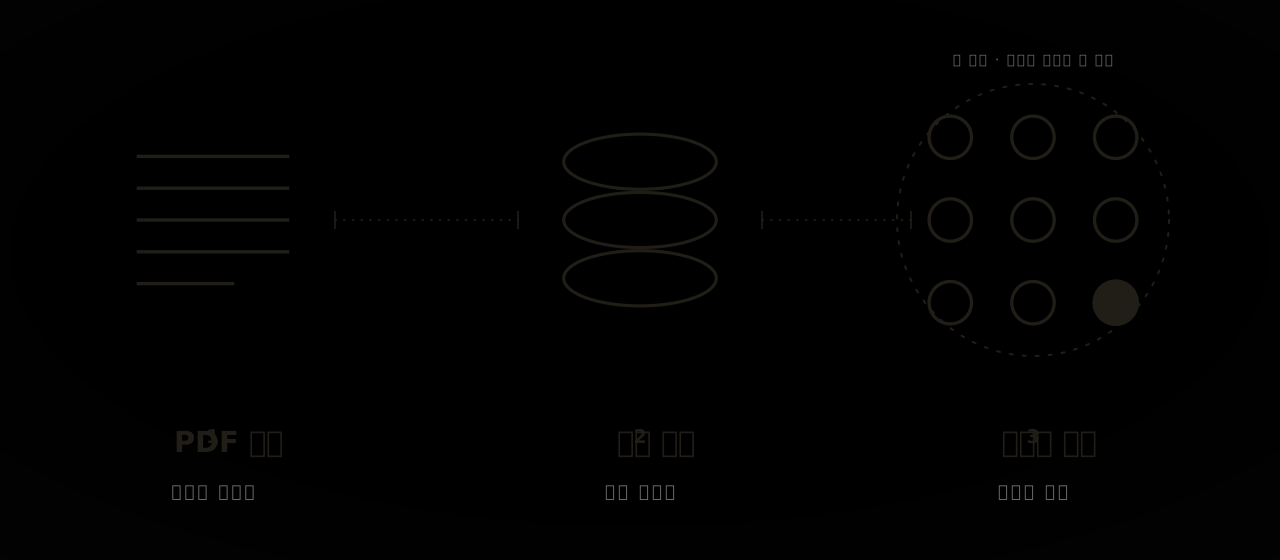
Why you shouldn't just dump the PDF in
When you feed an AI agent a whole PDF, it ends up re-scanning the table of contents and retracing its steps to find the relevant section on every single turn. Answering one question means reprocessing tokens equivalent to the entire book, over and over. book-to-skill is built to pay that structuring cost only once, at conversion time. It splits the book into chapter-level files and only pulls in the chapter that's actually relevant when you ask about that topic. According to the developer, this cuts the tokens needed to answer the same question by 24x to 51x compared to loading the whole book into context.
How it works
The architecture breaks down into two main parts. One is a deterministic Python extractor that turns the document into clean text and metadata. The other is a spec-driven generator, where the agent follows a SKILL.md document to assemble that text into a structured skill. Because this skill runs on the open Agent Skills standard adopted jointly by GitHub Copilot CLI, Amp, and Claude Code, all three hosts read the same SKILL.md format regardless of which one you use.
The tool also picks different extraction engines depending on the format: technical books full of tables and code blocks default to Docling, while prose-heavy books use the faster pdftotext. For scanned PDFs that are just page images with no extractable text, the converter checks the first few pages, stops right there, and explains why — rather than quietly producing an empty skill, it tells you to run OCR first.
How to try it
Where to start — If you're already using GitHub Copilot CLI, Amp, or Claude Code, the starting point is following the repository's install docs (docs/install.md) to hook the book-to-skill converter up to your host.
Step-by-step usage
- In your agent's chat window, type
/book-to-skill <file path|folder|glob> [skill name]. You can pass a single file, an entire folder, or a list of multiple files. - The converter detects the document format and automatically picks the right extraction tool to pull out text and metadata.
- The generator assembles the results into SKILL.md and per-chapter files, saving them into the skill directory appropriate for your host.
- From then on, you can ask
/book-name-slug your question, and the agent will pull in only the chapter file it needs and answer based on the actual text.
Who can use it — Any host that supports the open Agent Skills standard — GitHub Copilot CLI, Amp, Claude Code — can use this, and it's released free under the MIT license. That said, the book content itself isn't included in the repository; it converts files you already own, so copyright and terms of use are your own responsibility.
| Host | Skill storage path |
|---|---|
| GitHub Copilot CLI | ~/.copilot/skills/<slug>/ |
| Amp (cross-agent) | ~/.agents/skills/<slug>/ |
| Claude Code | ~/.claude/skills/<slug>/ |
What you can try — Despite the "book" in the name, the developer says any structured prose input works. Internal manuals, policy documents, or team documentation bundles you reopen often can be turned into skills the same way. One example in the repository describes converting a book on developer experience (DevEx) and using it as reference material for a survey of over 300 engineers.
Editor's take
What's interesting here isn't book-to-skill itself — it's the standard it's built on. As we covered back in early August in A guide to slash commands in the GitHub Copilot app, the Copilot app is moving toward automatically managing context, while as we saw in AWS brings open-source Agent Skills to Bedrock's automated reasoning policies, the Agent Skills format Anthropic proposed is expanding in the other direction, pulling in infrastructure companies like AWS. book-to-skill sits right at the intersection of these two trends — it means even a single individual user's book-length knowledge gets packaged in the same SKILL.md syntax as enterprise-grade skills.
If you've actually plugged in a tool like this before, the experience tends to feel familiar. Dumping the whole PDF in feels convenient for the first few exchanges, but the cost of re-scanning the same table of contents piles up as the conversation goes on. Splitting things into chapters and loading only what's needed eliminates that accumulating cost, but it asks for an extra upfront step: conversion. If your team is watching token spend, converting frequently-referenced internal docs into skills first is a sensible place to start. But if it's something you only look up once in a while, there's not much reason to bother converting it.
The design choice to filter out scanned PDFs upfront and explain why is also worth noting. Stopping before conversion saves more practical time than generating an empty skill and discovering the problem later. As more hosts come to support the Agent Skills standard, we'd expect more personal conversion tools like this one to show up alongside it.
Correction (2026-08-24) — The original article described this tool as newly released. The repository was actually created on May 1, 2026. The lede and summary have been corrected.


Comments