


Image: METAL
Summary
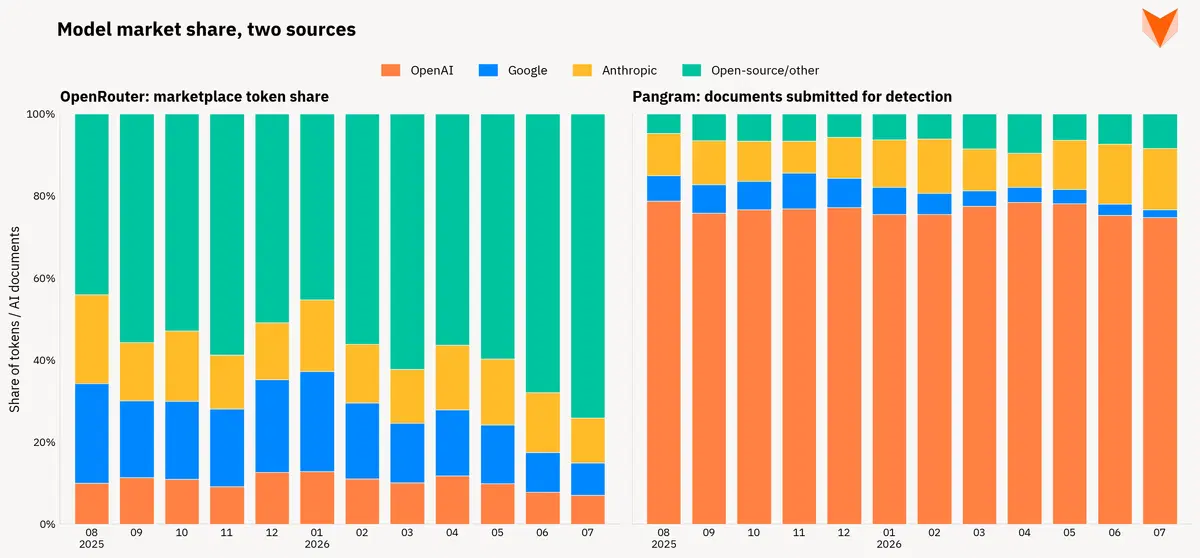
- Gemini's share fell from 12% to 1.9% according to AI text-detection firm Pangram
- Over the same period, OpenAI held steady above 50% while Anthropic rose from 4.3% to 14.9%
- OpenRouter and Similarweb data confirmed the same downward trend, which analysts say coincides with personnel changes inside DeepMind
From 12% to 1.9% in five months
According to model-share data compiled by AI text-detection platform Pangram based on submitted writing, Google Gemini once held a 12% share but had dropped to just 1.9% as of July 2026. Pangram described the figure as a "collapse." Over the same period, OpenAI maintained a share above 50% every month since tracking began, while Anthropic more than tripled its share, rising from 4.3% to 14.9%. Pangram noted that Anthropic's growth was especially pronounced in technical and scientific writing.
Three data sources, one picture
This isn't just a Pangram story. OpenRouter, which tracks API traffic across AI models, showed the same downward trend. Web analytics firm Similarweb showed Google's website share slipping slightly from 27% to 26.8% last month. That said, this figure still represents a major jump from 9.4% a year earlier. Three independently measured data sets point to the same conclusion: fewer people are turning to Gemini.
| Data Source | Measurement Method | Observed Trend |
|---|---|---|
| Pangram | Model detection on submitted text | Gemini 12%→1.9% (July) |
| OpenRouter | API traffic tracking | Same downward trend confirmed |
| Similarweb | Website visit share | Google 27%→26.8% (from 9.4% a year ago) |
Google has stated that the Gemini app has around 1 billion monthly users. However, critics note that monthly active users (MAU) is a loose metric that counts anyone who opened the app even once, making it an unreliable signal of actual usage intensity.
Blind spots in the share data
None of the three data sets are complete. Pangram mostly measures writing tasks, an area where Gemini already trailed ChatGPT and Claude. OpenRouter is a platform where traffic skews toward open-weight models, making it a poor proxy for commercial models overall. Similarweb doesn't track mobile app usage, meaning users who access Gemini through its app are excluded from its statistics. Still, the fact that all three point in the same direction is the central takeaway of this report.
| Provider | Pangram Share (July) | Year-over-Year Change |
|---|---|---|
| OpenAI | 50%+ | Held steady |
| Anthropic | 14.9% | Up from 4.3% |
| Google Gemini | 1.9% | Down from 12% |
What's happening inside DeepMind
Some analysts suggest this decline may not be unrelated to recent personnel changes inside Google DeepMind. Several senior figures, reportedly including Demis Hassabis, have left the organization. Earlier Reuters reporting also indicated that Google co-founder Sergey Brin has been pushing internally within DeepMind to allocate more resources toward developing "self-improving AI." Whether this share decline is connected to that internal tension remains to be seen.
So what does this change
This data doesn't necessarily mean Google's AI business is failing. Google expanded Gemini Spark to over 160 countries, including South Korea, on July 30, pushing a 24-hour agent that integrates with Gmail, Docs, and Slides, and is testing a new toggle for switching between chat and task modes in Gemini Enterprise, along with an agent for generating marketing campaigns. Still, the fact that three unrelated metrics all arrived at the same answer to the question of which model ordinary users choose when generating text is a signal that's hard to dismiss. As OpenAI and Anthropic settle into a pattern of splitting market share, the key question going forward is whether Google can reverse this trend with its next model generation.


Comments