


Image: METAL
Summary
- Hassabis is stepping back from DeepMind's day-to-day operations to become GDM Chairman and Alphabet Chief Scientist, while Koray Kavukcuoglu becomes SVP and will lead development of Gemini 4.
- Jeff Dean is leaving after 27 years to found the public-benefit company Discovery Loop. The company's notice mentioned only two people, but the actual founding team of four includes Oriol Vinyals and Quoc Le as well.
- Alphabet shares fell roughly 4% immediately after the announcement. The departures follow Noam Shazeer (to OpenAI) and John Jumper (to Anthropic) in June, and the exodus continues.
Google/Alphabet CEO Sundar Pichai announced a reorganization of Google DeepMind in an internal email on August 5 (local time), and the company published both his letter and a letter from Demis Hassabis verbatim on its blog. Hassabis is stepping back from day-to-day leadership of DeepMind, Koray Kavukcuoglu is taking over that role, and Jeff Dean, a 27-year veteran of the company, is leaving.
The tone of the letters was consistently one of "acceleration" and "momentum." The market read it differently. Alphabet shares dropped roughly 4% right after the announcement and slid as much as 5% intraday. This is the second decline following a 7% drop after last month's earnings report.
Three positions moved at once
Demis Hassabis becomes Chairman of Google DeepMind and Alphabet's Chief Scientist. He is stepping back from leading DeepMind day-to-day but is not leaving the company, and he will continue as CEO of drug-discovery company Isomorphic Labs. He joined when Google acquired DeepMind in 2014.
Koray Kavukcuoglu is being promoted to SVP of Google DeepMind. He was previously GDM's Chief Technology Officer and Google's Chief AI Architect, and in his new role he will report directly to Pichai. He will oversee Gemini model development, frontier AI research, and the Gemini apps and developer organizations. CNBC reported that he will lead development of Gemini 4, the next flagship model.
Jeff Dean is leaving after 27 years. He joined as Google's 30th employee in 1999 and helped architect the company's major technical transitions, from early search infrastructure to the neural networks that ushered in the modern AI era. Hassabis is filling the Alphabet Chief Scientist role that Dean is vacating.
The company's letter named two, but four are actually leaving
Pichai's letter mentioned only two people: Jeff Dean and Senior Fellow Sanjay Ghemawat. It did not name the new company or provide any details beyond its form.
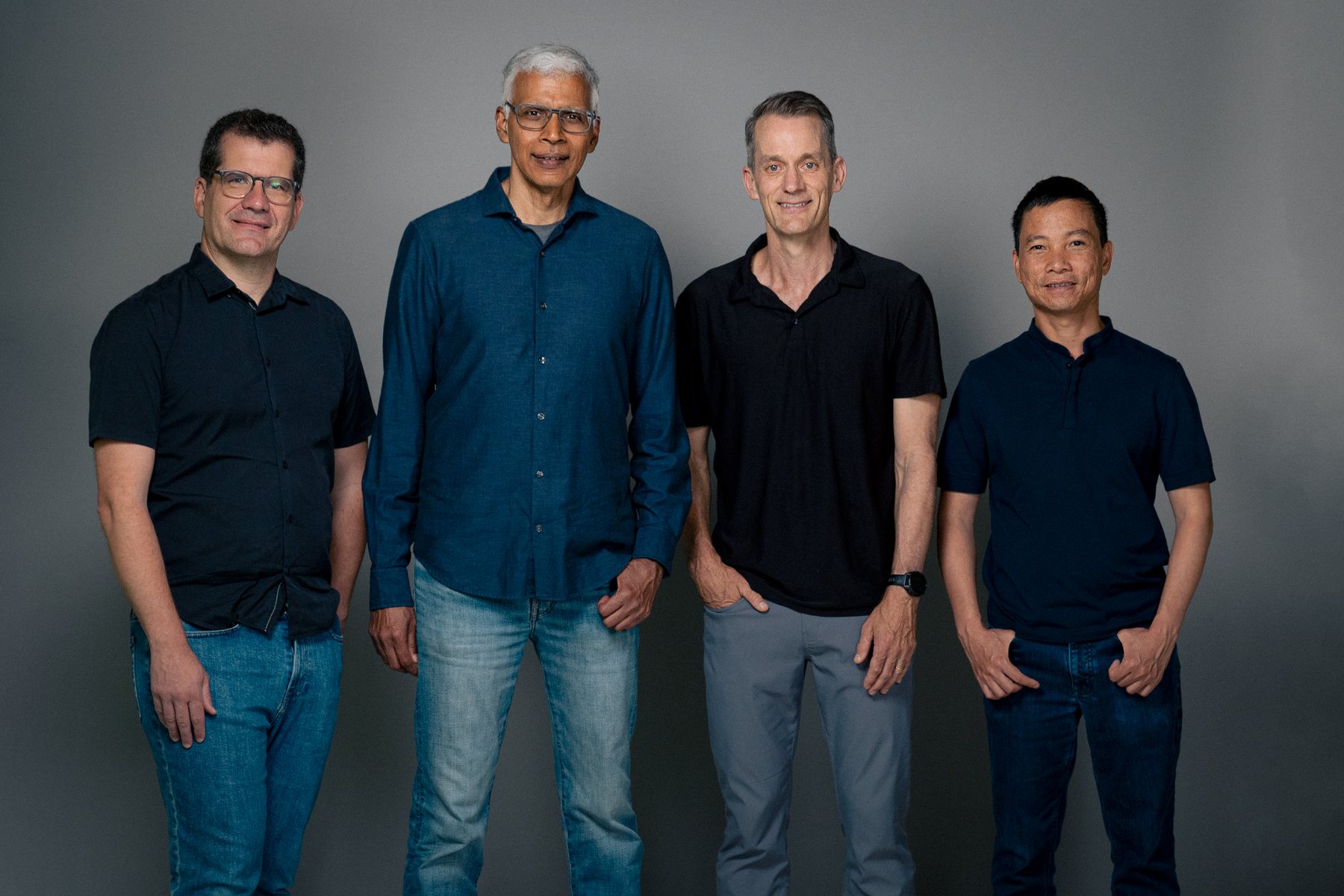
The full picture emerged hours later, when Jeff Dean posted directly on X. The new company is called Discovery Loop, and its founders — in addition to Dean and Ghemawat — include Oriol Vinyals and Quoc Le, making four founders in total. He wrote, "The four of us have worked together for anywhere from 14 to 30 years."
According to the company's own description, they describe themselves as "three of the most-cited researchers in AI and two of the most-cited researchers in distributed systems." In other words, the two people left out of the company's announcement are, if anything, closer to the center of gravity of AI research.
What Discovery Loop does
It is structured as a Public Benefit Corporation, and its stated goal is "to automate the experimental loop of science itself." The company's explanation continues: the scientific method is humanity's best tool, but its execution consists of a repetitive experimental loop that people run sequentially — which makes it slow and labor-intensive.
The approach has two stages. First, automate machine learning research and engineering; then apply that automation capability to their own technology stack first. The company described this as "we become our own first customer." The plan is to run thousands of experiments in parallel using frontier models and large-scale compute, compressing iteration time.

Google is not becoming a stranger to the venture. Pichai stated that Google will continue as a founding investor and cloud partner, and will collaborate on research frameworks for machine learning systems and infrastructure.
There is, however, testimony with a different tone. According to MarketWatch, Dean and his co-founders told the Wall Street Journal that they felt they had to leave Google to pursue their own research interests. This points to the same event Pichai described as "a moment when they wanted to try something new," but the temperature is different.
This is not the first time
The reason this announcement dragged the stock down 4% is not a single personnel change. The list of people who have left DeepMind this year is already long.
- Noam Shazeer — co-lead of Gemini. Announced his move to OpenAI in June.
- John Jumper — created AlphaFold and shared the 2024 Nobel Prize in Chemistry with Hassabis. Moved to Anthropic effective June 19, after nine years at the company.
- David Silver — led AlphaGo and the reinforcement learning team. Left DeepMind to found Ineffable, a company aiming for superintelligence, which according to CNBC raised $1.1 billion in seed funding.
Now these four are added to the list. Each case can be explained on its own, but the fact that the people who built DeepMind's reputation — AlphaFold, AlphaGo, Gemini — have left one after another within half a year is hard to explain away as individual circumstances. And the places they went — Anthropic and OpenAI — are exactly the rivals Google is now chasing.
The line Pichai quietly slipped in
The letter is largely filled with confident language: a full stack, talent and compute in place, and momentum confirmed across search, YouTube, and cloud businesses.
But in the passage describing Google DeepMind, one sentence stands apart in tone. "We've committed to staying at the frontier, and we're focused on areas where we need to improve." The very next sentence reads, "We need to keep moving quickly and with clear purpose here."
The context suggests why that sentence was included. The company has not yet shipped Gemini 3.5 Pro. Model delays combined with rising AI spending had already put pressure on Alphabet's stock.
The numbers embedded in the letters
Though this was a personnel announcement, performance figures were included alongside it.
- Gemini apps have more than 950 million monthly users
- Gemma models have surpassed 900 million cumulative downloads
- Strong demand for the Flash model, with the Cyber model now in service
- Progress in Gemini Robotics, announced last week
External figures should be weighed alongside these. In Q2, Google Cloud revenue grew 82% to $24.8 billion, far outpacing AWS (37%) and Azure (43%). At the same time, Google turned free cash flow negative for the first time ever, and its annual capex guidance stands at up to $205 billion. Growth and spending are both surging at once.
And buried in one line of Hassabis's letter is the name of a model not yet officially announced: "I'm excited about the great progress we're making on new models, including Gemini 4." No specifications or timeline were mentioned.
Why is Hassabis stepping back now
Pichai's explanation is straightforward. Hassabis has long said he is "standing at the foothills of the singularity" and is spending increasing amounts of time on external engagements; the two of them have long discussed a role that would let him focus fully on shaping the future of AGI.
Hassabis's own letter is more direct. "We have reached a pivotal moment in human history. I've worked toward AGI my whole life, and now, like many of you, I feel it's getting close," he wrote, adding that it is time to hand off day-to-day responsibilities and focus on the bigger picture. In his new role, he will discuss strategy and global AGI issues with Pichai at Platform 37, the new London headquarters building, and will advise GDM leaders including Koray.
He is also increasing his focus on Isomorphic Labs. "I've always believed that AI's number one application should be improving human health," he wrote. "What better way to prove AI's value beyond doubt than by finally curing diseases like cancer?"
Who is Koray Kavukcuoglu
If the name is unfamiliar, his track record explains the appointment. He has worked at DeepMind for 13 years, since its early days, and first built out DeepMind's deep learning team. WaveNet, which transformed speech synthesis, and DQN, the starting point of reinforcement learning, were both achievements under his leadership.
Hassabis wrote, "I've worked with Koray for over 13 years, and he's one of the best AI experts in the world," adding that "the Gemini models are in great hands with Koray and the leads — and in fact, they have been for a while." That last line reveals the true nature of this reorganization: operational leadership of Gemini development had already shifted, and this change simply brought the title in line with reality.
What remains unconfirmed
Discovery Loop's funding size and valuation have not been disclosed. How much Google is putting in as a founding investor, and what stake it holds, has also not been revealed. The company has said only that it intends to build "a lean, in-person team," without specifying hiring numbers.
On Gemini 4, the letter offers just one sentence. No launch timing, performance figures, or pricing were given. This should be read as nothing more than confirmation that a model name exists — no more.
The announcement made no mention of layoffs or organizational downsizing. Still, separately worth watching is the fact that leadership changes of this scale typically come with broader organizational restructuring.
Finally, neither letter addresses how the vacancies left by those departing will be filled. Pichai wrote only of "areas where we need to improve," without specifying what those areas are.


Comments