


Image: METAL
Summary
- A US federal court ruled that the supply-chain risk designation and government-wide ban against Anthropic were unlawful.
- The court affirmed the government's right to choose vendors but said market-wide retaliation for public criticism is not permitted.
- Anthropic won on the major constitutional and administrative-law claims but lost on the separation-of-powers claim and claims against several individual agencies.
Anthropic has won the merits of its lawsuit against a sweeping US government blacklist. Judge Rita Lin of the US District Court for the Northern District of California ruled on August 27 that the Defense Department's move to designate Anthropic a "national security supply chain risk" — and cut off dealings between the company and both federal agencies and defense contractors — violated the First and Fifth Amendments as well as federal administrative law.
The ruling does not mean the court forced the Pentagon to accept Anthropic's weapons policy. The opinion states plainly that the Defense Department remains free to choose whatever AI vendor it wants. What it cannot do, the court said, is use a breakdown in contract negotiations as grounds to push a critical company out of the entire government market.
From a March preliminary win to an August ruling on the merits
This decision is different from the preliminary injunction issued on March 26. That earlier order found the government's action was likely unlawful and would cause Anthropic irreparable harm, so it temporarily blocked enforcement. This time, the court reviewed the full record submitted by both sides and issued a 59-page summary judgment ruling on the merits of the key issues.
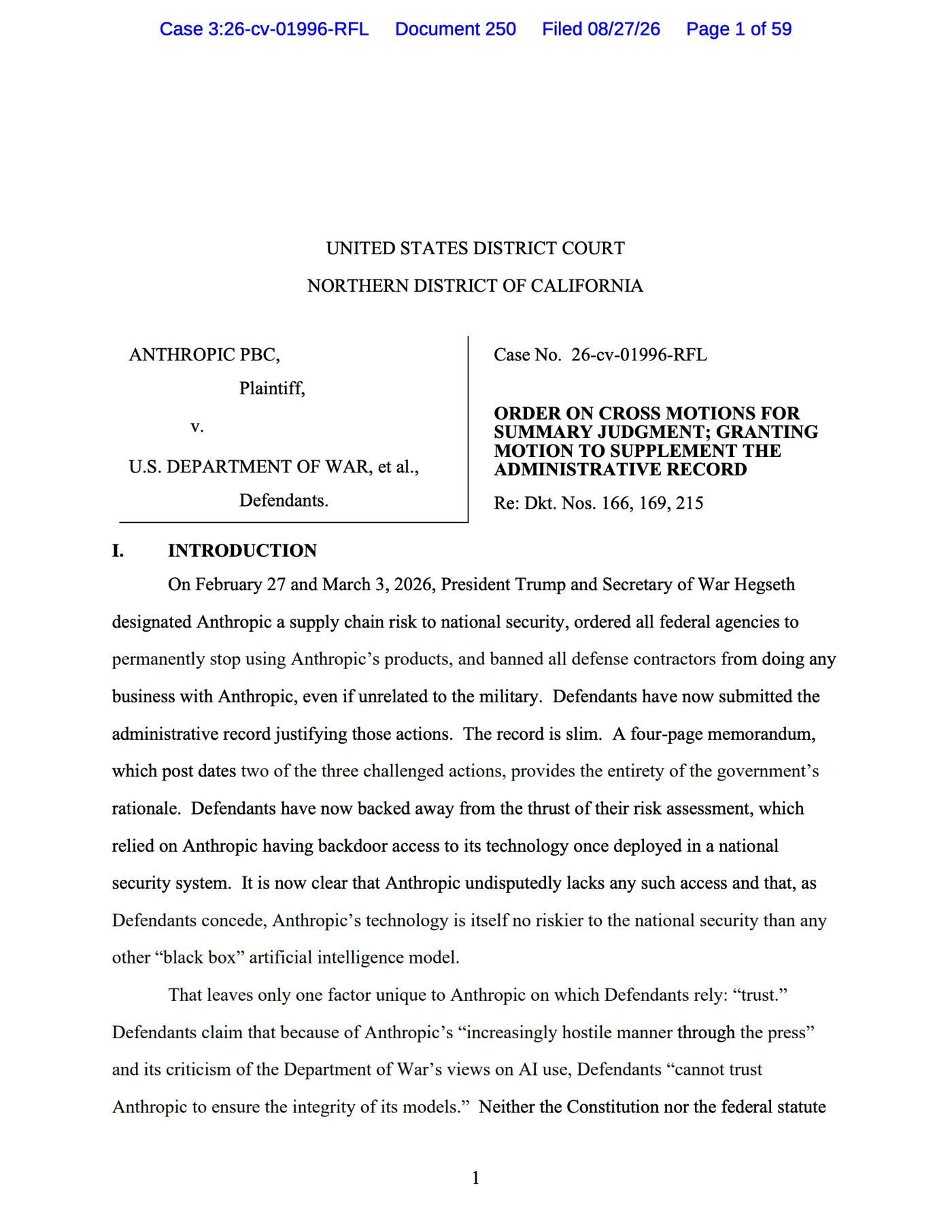
The sharpest criticism in the ruling targeted the government's justification. The Defense Department's administrative record relied essentially on a single four-page memo, and even that document was written after two of the three challenged actions had already taken place. The government initially cited the risk that Anthropic could access deployed models through a "backdoor," but during litigation it acknowledged that Anthropic has no such access.
What the court found actually remained unique to Anthropic wasn't a technical risk — it was what the government called "trust." The Defense Department's record described Anthropic as having taken an increasingly adversarial tone through the media. Judge Lin viewed this not as a national security risk assessment but as retaliation against a company that had publicly criticized the government's AI usage policy.
The dispute centered on two red lines
The conflict escalated when the Defense Department demanded contract terms requiring AI vendors to permit all lawful uses. Anthropic said it could lift most restrictions but drew the line at two things: large-scale domestic surveillance of Americans, and fully autonomous lethal weapons that select and strike targets without human involvement.
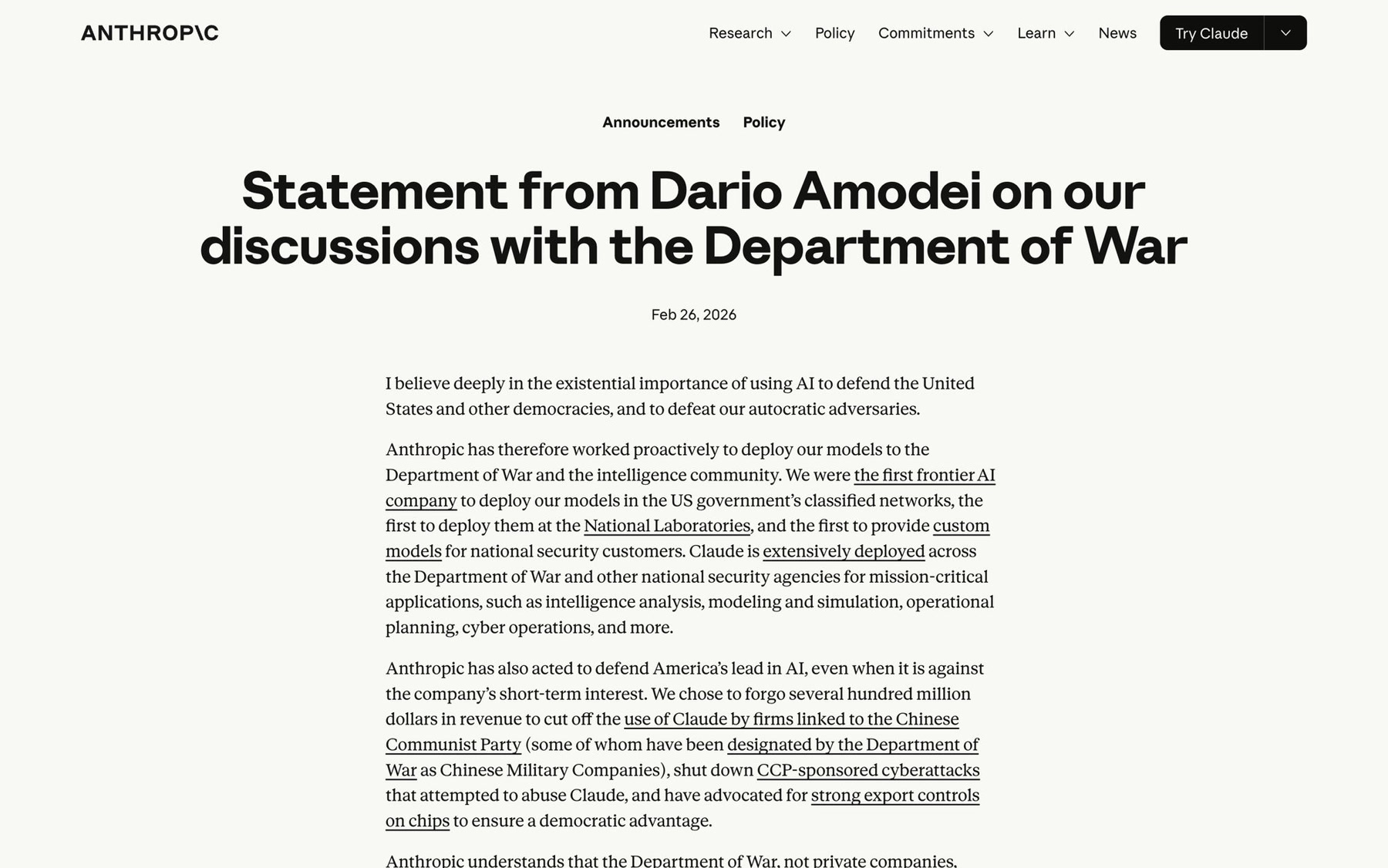
In an official statement on February 26, Anthropic acknowledged that military decisions belong to the Defense Department, not a private company. At the same time, the company argued that current frontier AI is not reliable enough to safely operate fully autonomous weapons, and that large-scale domestic surveillance is an area where the law hasn't kept pace with the technology. Anthropic wasn't asking to pick its own customers — it was simply stating two uses for which it could not provide its product.
The next day, President Trump directed all federal agencies to stop using Anthropic's technology, and Defense Secretary Pete Hegseth designated Anthropic a supply-chain risk. The order also included a secondary boycott provision barring companies that do business with the Defense Department from engaging in commercial activity with Anthropic even in matters unrelated to the military. The court ruled that supply-chain laws originally designed to block interference by foreign intelligence agencies or terrorist organizations could not be stretched to cover this kind of situation.
The government can switch vendors, but it can't punish them
The most important line in the ruling is that "national security" isn't a blank check that justifies anything. The court affirmed the government's freedom to stop using Claude and choose a different AI vendor. But it ruled that blocking Anthropic across the entire federal government and the private defense market because of its public criticism amounted to retaliation prohibited by the First Amendment.
Process was also an issue. Anthropic was never notified or given a chance to respond before being designated a supply-chain risk. The Defense Department kept no specific record showing it considered less intrusive alternatives, and it failed to properly follow the risk-assessment procedures required by law from designated officials. The court found this violated the Fifth Amendment's due process guarantee and the Administrative Procedure Act.
The ruling vacated the government's actions and issued a permanent injunction. The government's request for a seven-day stay was also denied — the same measures had already been on hold since March, and the government failed to show it would suffer irreparable harm from the denial.
Not a total win
Anthropic did not prevail on every claim. The government won on the claim that the president's directive itself violated separation of powers through an ultra vires exercise of authority. Anthropic's claims against several individual agencies — including Health and Human Services, the Commerce Department, Veterans Affairs, the SEC, and NASA — were also rejected because no final agency action had been confirmed.
A separate supply-chain case remains pending before the DC Circuit Court of Appeals. This California ruling does not resolve that case. There is talk that the government may appeal to the Ninth Circuit, though as of this ruling it has not been confirmed that a notice of appeal has actually been filed.
In court filings, Anthropic argued that if the sanctions were reinstated, revenue from defense-related customers could fall by 50 to 100 percent, translating into billions of dollars in lost revenue for 2026 overall. That figure is not an independently verified financial result — it is the company's own litigation estimate. The Defense Department contract worth up to $200 million that Anthropic signed in July 2025 is also not a new deal won as a result of this ruling.
Editor's take
The real question in this case isn't whether an AI company can control the military. The court never answered that question, and it affirmed the Defense Department's right to choose a different, less-restricted model instead. What the ruling blocked wasn't a buyer's choice — it was the government mobilizing its purchasing power and regulatory authority together to push a critic entirely out of the market.
In an ordinary business relationship, if a deal falls through, you cut ties and find another supplier. Government contracts are different. When a breakdown in negotiations with one agency spreads into a ban across every federal agency — and further, into a ban on private companies that do business with that agency — the government ends up holding both a giant megaphone and the keys to the door at the same time. That's exactly why the court drew a distinction between "a failed contract" and "public retaliation."
AI safety standards should be read through the same lens. There's no guarantee that every restriction a model company sets is correct, and a private company shouldn't be substituting its own judgment for democratic oversight. But the government, too, cannot erase the possibility of technical failure simply by invoking a broad phrase like "all lawful uses." Safety standards only get properly tested when two parties with different responsibilities are able to openly clash over them.
This ruling did not enshrine Anthropic's two red lines as official US military AI policy. Instead, it established the principle that an AI company should not be turned into an enemy of national security merely for criticizing government policy in public. In an era when AI companies and state power are negotiating with each other, what's needed isn't a loyalty contest that forces silence — it's a process for defining the boundaries of a contract while still leaving room for dissent.
Sources
- U.S. District Court, Northern District of California — ORDER ON CROSS MOTIONS FOR SUMMARY JUDGMENT →
- Anthropic — Statement from Dario Amodei on our discussions with the Department of War →
- The New York Times — Trump Administration’s Blacklisting of Anthropic Was Illegal, Judge Rules →
- CNBC — Judge blocks Pentagon blacklist of Anthropic as supply chain risk →


Comments