


Image: METAL
Summary
- Uptime Institute analyzed more than 1,200 respondents to its 2025 and 2026 annual surveys and found that 39% of sites with 2N cooling reported an impactful outage in the past three years, versus 70% of sites using N.
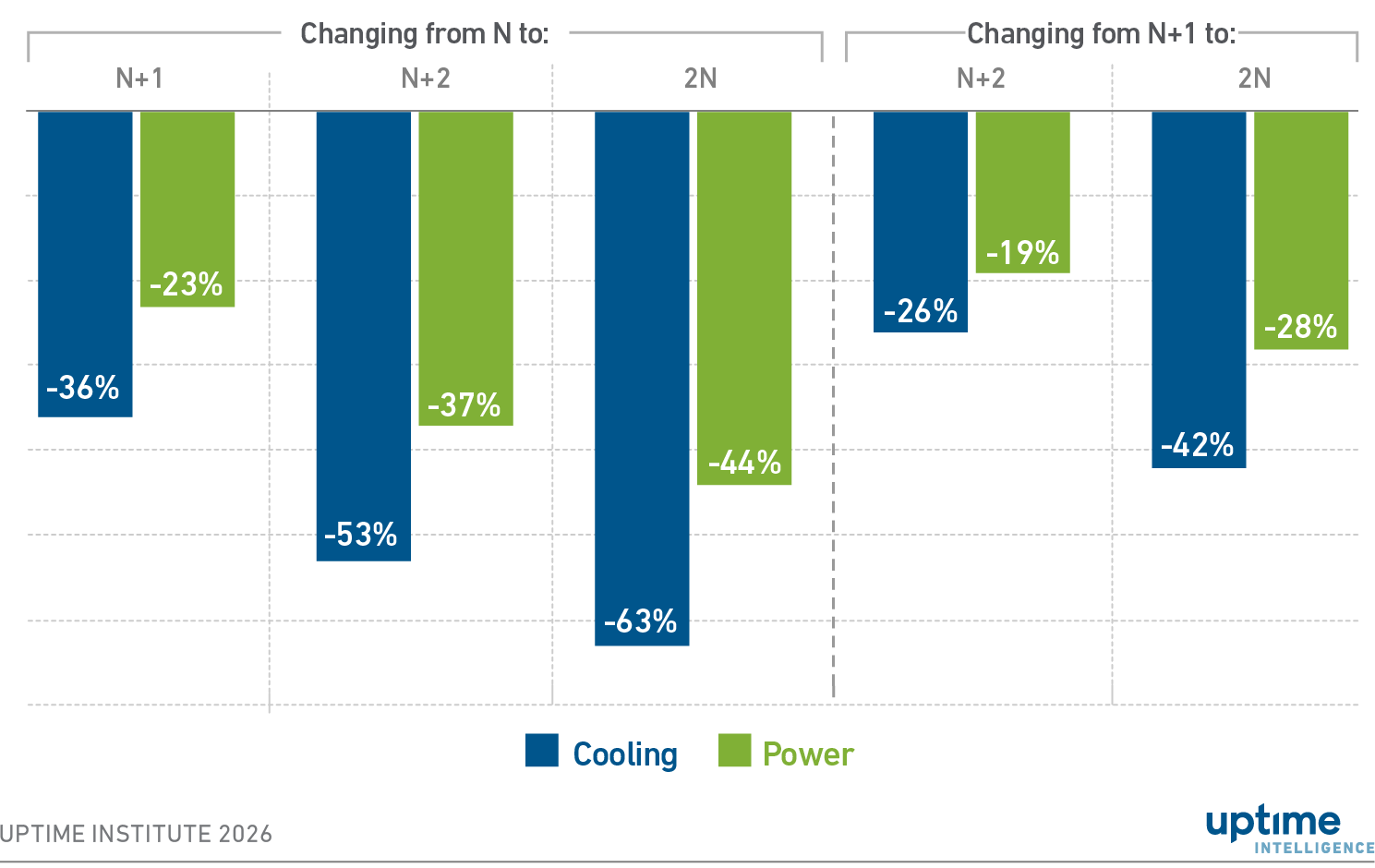
- Compared with N, the likelihood of a financially damaging outage was 36%, 53% and 63% lower for N+1, N+2 and 2N cooling, and 23%, 37% and 44% lower for power.
- The authors said correlation is not causation, but that the figures can serve as a benchmark for operators weighing the cost of additional infrastructure against downtime risk.
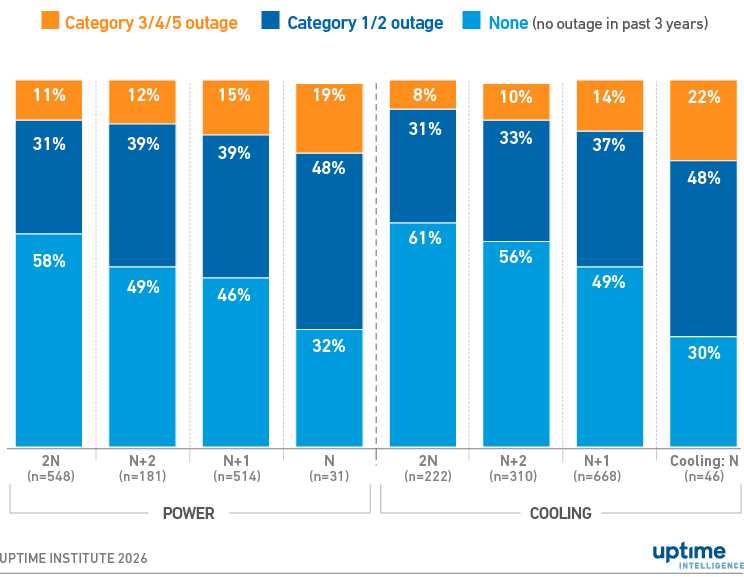
Data center operators with duplicated power and cooling systems reported far fewer outages than those with no spare capacity. According to an analysis published on October 14 by Uptime Institute, an organization that assesses data center reliability, 39% of respondents with fully duplicated (2N) cooling had experienced at least one impactful outage in the past three years, compared with 70% of those whose capacity is sized exactly to peak load with no spare (N). Power showed the same shape, at 42% for 2N and 68% for N. The likelihood of a financially damaging outage was about 63% lower with 2N cooling than with N.
The analysis rests on two years of surveys. Uptime combined its 2025 and 2026 annual global data center surveys into a sample of more than 1,200 respondents. Operators reported whether their primary data center had suffered an impactful outage in the past three years and, if so, rated the most recent one from category 1 (minimal impact) to category 5 (severe). Categories 3 to 5 broadly represent outages with meaningful financial impact. Uptime then cross-tabulated those answers against each site's power and cooling redundancy configuration.
Redundancy comes in four levels. N is sized to the expected peak load, so if a critical component fails the system may no longer support the full load. N+1 adds one extra component, letting a site ride through the failure or maintenance of one component without service loss. N+2 adds two, so one component can be offline for maintenance while another fails. 2N duplicates the full required capacity, creating two independent paths that can each carry the entire load.
The less headroom, the more outages. Respondents using N+1 and N+2 reported outages less often than those on N and more often than those on 2N, so both cooling and power moved in steps with the level of redundancy. The gap was even wider for serious outages. Category 3 to 5 outages were reported by about 8 to 11% of respondents with 2N and about 19 to 22% of those with N. The results suggest redundancy lowers not just the number of outages but the odds of a major incident.
Uptime turned those rates into figures that can inform investment decisions. According to the original charts in the report reviewed by METAL, compared with N, the likelihood of at least one financially damaging outage in three years was about 36% lower for N+1 cooling, 53% lower for N+2 and 63% lower for 2N. For power, the reductions were about 23%, 37% and 44%. Because few data centers run with no redundancy at all, Uptime offered N+1 as a more realistic baseline; measured against it, 2N cooling is 42% less likely to have an outage and N+2 cooling 26% less likely.
"Correlation is not causation," wrote the report's authors, Owen Rogers, senior research director for cloud computing at Uptime Institute, and senior research associate Douglas Donnellan. The analysis cannot separate the effect of redundancy from other characteristics such as operational maturity, maintenance practices, equipment condition and overall system design, and not every outage respondents reported was caused by power or cooling. Even so, power and cooling together accounted for more than two-thirds of impactful outages in the 2026 survey. Results for N configurations should be read with caution because the samples are small, but the same pattern holds when N is excluded and N+1 and N+2 are compared with 2N. Chris Brown, Uptime's chief technology officer, was consulted for the analysis.
The authors' conclusion is about putting a number on redundancy. "Redundancy does not eliminate outages, but it is associated with a material reduction in the likelihood of experiencing a serious outage," they wrote. The figures do not predict the benefit for an individual facility, but they give operators an indicator to use when weighing the cost of additional infrastructure against their exposure to downtime. A benefit that everyone takes for granted but rarely quantifies now has a rough order of magnitude.
The numbers land in the middle of the debate over what data centers cost. METAL previously reported on a United Nations University report on the carbon, water and land costs of data centers. A 2N design means building the entire required power and cooling capacity twice. Deciding to equip a site twice over is also a decision about who bears the risk of an outage. Uptime's analysis offers a starting point for making that decision on probabilities rather than instinct.


Comments